Recently I was given the opportunity to review Edward O. Wilson's The Meaning of Human Existence (2014) for the July/August 2015 issue of The Humanist, the official magazine of the American Humanist Association. Though I think the book serves more as an addendum to On Human Nature (1978) and Consilience: The Unity of Knowledge (1998) than a single, independent work, it's undoubtedly worth the read. Though he tries to cover a lot in this book, its best chapters are those when, rather than approaching the humanities with a fist, he opens his hand.

The Wilderness of Big Bend National Park
Covering more than 801,000 acres, Big Bend National Park is Texas’ largest park and one of its last untouched wildernesses. On the southern part of the state’s mountain and basin region, 118 miles of the Rio Grande River forms a natural border with Mexico. Of the fourteen national parks with mountains, Big Bend is distinguished … Continue reading The Wilderness of Big Bend National Park

Once again we are reminded that not every brain develops the same
In the fall 2012, I briefly left the University of Minnesota Morris to do a series of directed studies in Houston, TX. One of these included attending Dr. David Eagleman's "Neuroscience and Law" course at Rice University, which required that we write for the Initiative on Neuroscience and Law's blog. This was originally published September 26, … Continue reading Once again we are reminded that not every brain develops the same

Reading “Self Published Kindling: Memoirs of a Homeless Bookstore Owner” by Mik Everett
As part of a project I'm doing on the state of contemporary writing, author Mik Everett mailed me a copy of her book Self Published Kindling: Memoirs of a Homeless Bookstore Owner (2013). After reading it, I'm excited for what our generation has to offer the literary world. As Everett so clearly illustrates: we're one of dreamers and as we set out, so much of what we have to say will be about how we maintained this spirit while navigating the world given to us by our parents. (And if you've paid any attention to the news at all, it's not a great one). Written while living out of a broken-down RV in a Wal-Mart parking lot, Self Published Kindling is about Everett's experience running a Longmont, Colorado, bookstore that stocked exclusively self-published and regional books. Though the first store of its kind in the nation, Everett quickly discovers that few writers read and even fewer readers want books you can't find in a Barnes and Noble. She tries to mitigate this through author readings and art crawls, but everyone who comes in leaves empty-handed. Soon she and her partner, John, conclude, "Everybody's just here to pretend they support art" (48). If you're an artist who's ever tried to sell their work, you know exactly what that means.
Philip Larkin on reading versus hearing poetry
In order to familiarize myself with the work of English poet Philip Larkin, I recently read his 1982 interview with The Paris Review (its famous "Art of Poetry" series is a resource I encourage all writers to check out). Regarded as one of England's top poets, during his lifetime Larkin shied away from his fame, working … Continue reading Philip Larkin on reading versus hearing poetry

Read “Exodus of the Dead” in Popshot Magazine (UK)
What if the freshly-dead refused to drop as gravity intended -- and instead, simply floated away? In my latest short story, "Exodus of the Dead," I answer this question, envisioning a world where crime scenes are harder to discern without a victim and nobody fights over the airplane window seat. Written in the magical realist … Continue reading Read “Exodus of the Dead” in Popshot Magazine (UK)

“Words were powerless”: A Minnesota newspaper’s response to the Lincoln assassination
On April 15, 1865, lying in a boarding house across the street from Ford's Theater, President Abraham Lincoln died, the victim of an assassin's bullet. What was a week celebrating an end to four years of bloodshed was capstoned by one last tragedy. Though not everyone felt the same way, tens of millions mourned their fallen hero, and in Minnesota as well as elsewhere, this sorrow turned into disbelief, into anger.
The Funeral of President Lincoln
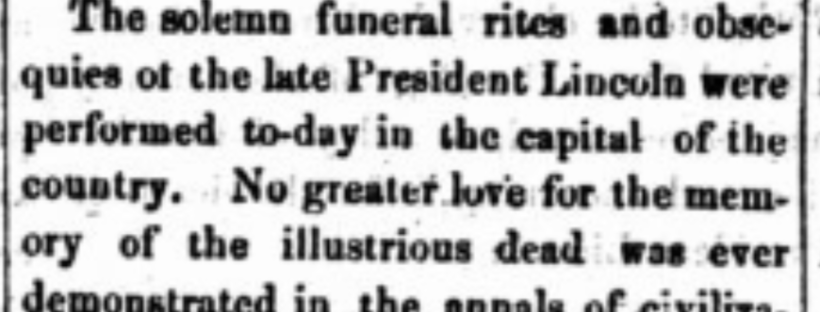
This month marks the 150th anniversary of President Lincoln's assassination. Given the historical distance, though, it's hard for us to really appreciate how traumatic this event was -- especially when, in the days preceding it, there was so much to celebrate. On April 9, 1865, Confederate General Robert E. Lee surrendered at Appomattox, effectively ending the Civil War. But ten days later, the colors of victory faded black as the president's hearse moved solemnly through the streets of Washington. The St. Cloud Democrat (Minnesota: April 27, 1865) ran an account of the three-mile-long procession, which I've reprinted below. As you read it, imagine for a moment what it must have been like watching the carriages move past. Though the war was over, tremulous times lied ahead. The reconstruction of a nation began with a tomb for its moral compass.

Holding Robert Bly’s Diaries
Going through Bly's diaries and correspondence spanning his entire life, I felt empowered watching this writer grow, discovering that the youthful doubts I harbor are doubts he harbored, too. It felt validating. (I don't expect anyone but the writers in the audience to understand what I mean by this). Sometimes I'd even stumble across lines that, in variation, have appeared in my own diary ...
The Death of Tomas Tranströmer
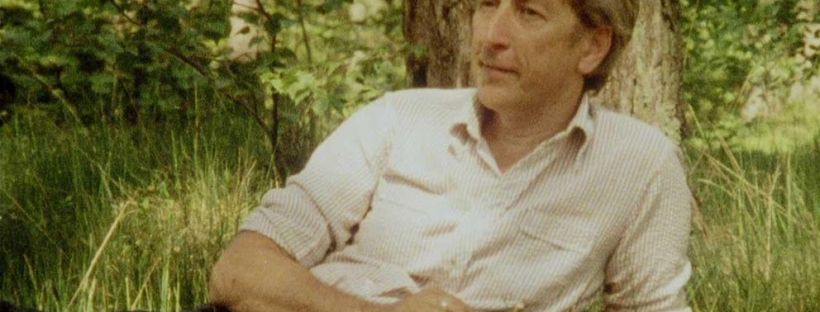
I was saddened to read about the death of Tomas Tranströmer, the Swedish Nobel Prize-winning poet. Perhaps like so many others, I'd discovered Tranströmer late, and in fact, when he'd won the prize in 2011, it was my first exposure to him. Unfortunately, as this was around the time I'd decided to to become a Serious Writer, my … Continue reading The Death of Tomas Tranströmer
 Joshua Panduro Preston