Read my review of Joseph Amato’s “Buoyancies” in the Rain Taxi Review
I'm happy to announce that my review of Joseph A. Amato's Buoyancies: A Ballast Master's Log (Crossings & Spoon River Poetry Press, 2014) appears in the latest print edition of The Rain Taxi Review of Books. Don't worry: My article's short. (Plus, if you get bored of my writing, you can literally turn the page and read an interview with Beat poet Diane di Prima).

The flapper’s a “young bird unable to rise in flight” (c. 1917)
During the late-1910s, Winona Wilcox was a syndicated columnist called by The Day Book, "a writer of the human heart." Writing during the Great War and the peak of the women's suffrage movement, her articles were witty and sarcastic, and on the topics of marriage and womanhood, in some ways, progressive. Though still constrained by the conservatism of the time, Wilcox often advocated for female economic independence and co-equal marriage. Given her pedestal, her work was often the first exposure many readers had to these developing ideas. In this article from January 10, 1917, she plays the role of social observer, reporting on a new phenomenon that would become the major trend of the next decade: the flapper. Marking an end of the Victorian Woman, this was a new femininity Zelda Fitzgerald embodied and her husband F. Scott immortalized in This Side of Paradise (1920). This was a postwar woman: independent, unconventional, self-expressive. The flapper was, in Wilcox's words, "more nearly the equal of the male than at any other age, and ... very apt to let him know it." ...

“Put it down the window and climb out”: Vice-President Humphrey at the University of Minnesota (1969-1970)
In March 2013, while writing my undergraduate history thesis on Hubert Humphrey’s role in the 1944 DFL merger, I spoke with University of Minnesota professor emeritus Dr. Hy Berman. As Minnesota’s “unofficial state historian,” I was excited not only to meet him but also discuss his friendship with the former vice president. One topic we spent much time on was Humphrey’s teaching at the University. All uncited quotations come from the transcript of our interview. [Excerpt]: "His office on campus was on the second floor of the Social Science Building — a corner office — and the Secret Service was still … protecting him. When they saw his office, they came to me and said, “That’s unacceptable,” because he was in a corner office, isolated. I said, “Well, that’s the biggest office. We’re going to furnish it nicely,” and they said, “We’re very unhappy.” "That evening I went to the hardware store and bought a rope ladder. I didn’t know what I was doing, but I brought it up the next day, went to the Secret Service guys and said, “This will do: Put it down the window and climb out.”"
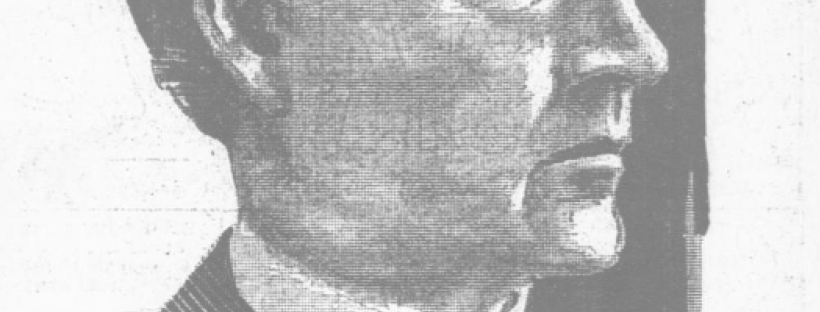
John Lind, Minnesota’s only Populist governor
This is a follow-up to a previous article called, "Digital Humanities: Newspaper Mentions of Four MN Governors" and this short note on John Lind serves two purposes. The first is practical, the other political. (And yes, all history is political). First, there are few easily-accessible resources discussing Lind's politics. [...] Second, as Orwell said, "The most effective way to destroy people is to deny and obliterate their own understanding of their history." Having served on a Texas textbook review panel, I've seen firsthand historical revisionism. I've seen Tea Party rhetoric creep into how we write about the past: The framing that government has always been an unnecessary evil, taxes an infringement upon liberty. Yet, when it comes to workers and women's rights, public education, the social safety net -- all the things that allow people to live with dignity -- these were not gifts of the free market or God but rather the product of struggle. These came from grassroots organizing. These came from rising up against power. It came from the notion that a government of the people could be proactive and a force for good. Minnesota is full of such stories, and it's about time we've heard them.

Garrison Keillor to Robert Bly: “Few poets can re-order our consciousness…”
While going through the Robert Bly Papers at the University of Minnesota, I came across two letters I wanted to share. In the past I've posted pieces from young writers like Oscar Wilde, Aldous Huxley, and Hunter S. Thompson, but the following come from two of the state's most-famous contemporaries. The first excerpt is from Garrison Keillor (age 27) and the other from Bill Holm (age 26). Both letters are dated 1969 and written after Bly gained fame for his literary magazine The Fifties (then The Sixties) and first book of poems, Silence in the Snowy Fields (1963). In 1966, Bly co-founded American Writers Against the Vietnam War and through it staged readings on college campuses across the country, which introduced him to many young poets. This kind of literary activism culminated in his winning the National Book Award for his politically-charged The Light Around the Body (1967). It is hard to overstate the influence Bly had on his contemporaries during the decade. Although both Keillor and and Holm later found their own fame for A Prairie Home Companion and The Music of Failure (1985), respectively, these were still decades away. In fact the two would become good friends with Keillor calling Holm, "The sage ... a colleague of Whitman born one hundred years too late."
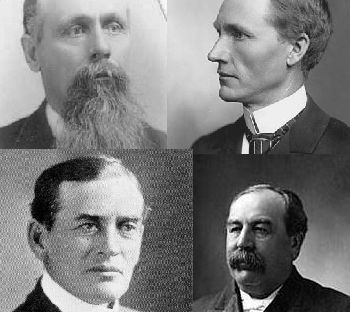
Digital Humanities: Newspaper Mentions of Four MN Governors
As I've written elsewhere, given my time at the Initiative, I've developed an interest in Big Data analysis and how this methodology can be applied to history ("the digital humanities"). Specifically, as collections become digitized, the sheer volume of resources ought to inspire historians to find new ways to engage and manage information. While the result will only be as good as the analysis, it has the potential to reveal trends that otherwise may be implied but not obvious. The following tracks the state newspaper mentions of particular keywords -- in this case, names -- of four Minnesota governors: David M. Clough, John Lind, Samuel R. Van Sant, and John A. Johnson. For example, every instance in which "John" and "Lind" appear within five words of one another on a Minnesota newspaper page, that page is counted. Searching for variations of how these individuals were addressed (such as "Governor Van Sant" rather than "Samuel Van Sant" or "S.R. Van Sant") yield different counts but the overall trends are the same.

The Atlanta Neuroethics Consortium: Neuro-Interventions and the Law
This is my “Voices in Bioethics” write-up of last month’s Atlanta Neuroethics Consortium. It was my first foray into the law and neuroscience world — and I loved it. What I don’t talk about is my experience using Couchsurfing.com (great!) or why I missed the Sunday panel.
With my flight leaving Sunday evening, I spent the morning walking to the Carter Presidential Library but gave up when I realized I’d never make it. Compensated by visiting the Martin Luther King Historic Site. Very good.

by Joshua Preston •
Recently, I attended the Atlanta Neuroethics Consortium’s (ANEC) conference on Neuro-Interventions and the Law: Regulating Human Mental Capacity (September 12-14). Hosted by Professor Dr. Nicole Vincent, it was my first foray into the “neurolaw” world. Most of the attendees and keynote speakers were pulled from the MacArthur Foundation’s Law and Neuroscience Research Network, and because of this, I was impressed by the cross-disciplinary representation. The conference included experts in the biological sciences and psychiatry as well as legal scholars and practicing judges. Additionally, I must add, it was free, which is the best price.
The opening keynote from Vincent laid out the major topics that would be explored over the next three days. In it she outlined her taxonomy of the relationship between responsibility and mental capacity (i.e., how does an individual’s cognitive abilities affect our expectations of them?). Each panel addressed…
View original post 797 more words

The Digital Humanities and Word Clouds
Ever since I joined the Initiative on Neuroscience and Law, I've had a growing interest in big data analysis. With so much information being digitized -- whether it's criminal records, government documents, or historical archives -- researchers can engage with old resources in new ways and ask questions on scales previously unimaginable. Though I'm not too vocal about it here (yet), right now I'm working to apply what I've learned at the Initiative to the Library of Congress' "Chronicling America" archives. This crossing of fields, for those who are curious, is called the "Digital Humanities." (If you'd like to know more, I suggest checking out the historian Dan Cohen's blog. Fred Gibbs also has a helpful introduction to historical data analysis here). I won't reveal any of my graphics here (I'm saving them for a future post), but here's an example of the Digital Humanities that everyone's familiar with: Word clouds. Technically, these were possible before the digitization of famous works, but it's the kind of work that required slave labor teaching assistants. The following I put together in a few minutes using Project Gutenberg and Wordle.

Governor Floyd B. Olson on Law School Debt
After working a series of odd jobs around the country, in 1914, at the age of 21, Olson returned to Minneapolis and attended night-classes at the Northwestern College of Law (now the William and Mitchell College of Law). The next year he graduated and passed the bar exam. But after doing so, he was sued by his law school over unpaid tuition fees. What happened next is recounted by Joseph Poirier, a college friend and later Minneapolis Municipal Judge (1937-1942): "... I recall that one of the first lawsuits Floyd tried was one in which he was a defendant. He was sued by [the] law school for an alleged unpaid balance on his tuition fee. He defended his own case, and I well recall his defense, in which he was Exhibit One as well as defendant. His argument was: "I know nothing about law, have learned nothing; and while I have been admitted to practice, you can readily see that I am no lawyer. My ignorance of the law, and the way I try this case are clear proofs that I have received nothing by reason of my alleged instruction at this school." And, strange to say, the jury found for him." (32)
 Joshua Panduro Preston