On women “mother-naked before long mirrors”: Dorothy Parker’s list of literary cliches to avoid

Recently I bought a copy of The Portable Dorothy Parker (Penguin Books, 1973) and am now reveling in her genius and wit. For those unfamiliar with Parker (1893-1967), she was a writer and columnist whose book reviews frequently appeared in The New Yorker (1927-1933) and Esquire (1957-1962). In the few reviews I've written, I often feel compelled to be … Continue reading On women “mother-naked before long mirrors”: Dorothy Parker’s list of literary cliches to avoid

Other Charity Challenges That Didn’t Catch On

By now, I'm sure your Facebook feed has been overrun with videos of friends and people-you forgot-were-friends participating in the ALS Ice Bucket Challenge. According to their own estimates, as of September 8, 2014, the ALS Association's raised over $111 million dollars, which is more than four times their annual budget. That's pretty awesome and it's going to do a lot of good. Much like a straight-to-DVD film with a title practically indistinguishable from a summer blockbuster, though, (I'm looking at you Transmorphers), the ALSA's success has not escaped imitation. It's unlikely you'll see your school president participating in any of the following, but they're worth suggesting. Here are the other charity challenges that didn't quite catch on.

What Did I Get Out of It? – Joshua P. Preston

Four years ago I was invited to attend the National Rural Youth Assembly in Santa Fe, NM. There I joined 50 other young activists to discuss rural issues and policy, but being nineteen, I spent most the time quiet, nervous. Looking back, though, it was an experience that later framed my work in the DFL Party and elsewhere. In this brief article, I discuss how so.

[Excerpt]:
Following the election, I spent the next two years attending as many DFL meetings as I could, spending all of my money on gas. Quickly, I developed the reputation of being “That Guy from Morris,” and, at the 2012 State Convention, was elected to serve on the DFL State Executive Committee. As both the only rural youth and its youngest member overall, I served one two-year term doing what I could to make the party more welcoming to young people.

While serving, I also immersed myself in the state’s rural political and literary history. Everyone wants to see their home, their experiences, represented in the culture, so I read everything I could. I read about the Nonpartisan League and the Farmer-Labor Party. Through Sinclair Lewis, Robert Bly, Paul Gruchow, and others, I saw through their eyes the prairies I walked, the same roads I drove, the people I knew. Together these gave me a broad sense of what rural organizing could amount to and formed the basis of my own rural identity. The development of this identity is the difference between being from just another small town and a hometown. Without it, there is no sense of place. …

jsmithyouthbuild's avatarNational Rural Youth Assembly

NRYA_Logo_Shirt

What Did I Get Out of It?

When I attended the National Rural Youth Assembly, I was a freshman at the University of Minnesota Morris. Being nineteen, I had no experience in politics and no grasp of public policy. So, traveling to Santa Fe, I worried whether I’d have anything to contribute – and, as I discovered, I didn’t. Nervously, shuffling from one workshop to another, I filled my notebook with everything I heard. Two days later, when I was on the plane back to Minnesota, I wondered what the experience meant. What did I get out of it? At the time, I wasn’t sure, but in one’s formative years, mere exposure is its own takeaway.

Looking back four years later, I take it for granted that I have an immense pride being from southwestern Minnesota. Far from being an epithet, I embrace the label “rural,” and am proud knowing…


View original post 758 more words

Midwestern Gothic: Summer 2014 issue

Recently, I subscribed to Midwestern Gothic, a quarterly print literary journal out of Ann Arbor, MI. Before subscribing, I'd stumble occasionally over their work and and was always impressed by what I saw. In a region of the country that many dismiss as "flyover territory," MG is evidence that even if there are planes in the sky, there are feet on the ground and stories in our heads. This is where the next generation of Midwestern writers are publishing. I was excited then when, last month, the Summer 2014 issue arrived in the mail. Of the 37 stories and poems, several stood out that I recommend. These are worth the price of admission alone, and I suggest you check them out.

How not to report the news: Food stamp fraud edition

After my father died, growing up, my family depended on entitlement programs like WIC, free school lunch, and the Supplemental Nutrition Assistance Program (SNAP). Hardly the mystical "Welfare Queens" conservatives imagine, we were just a low-income, single-parent household. You know, like a lot of families who rely upon these programs. By not worrying about where my … Continue reading How not to report the news: Food stamp fraud edition

The Time’s Don’t Change: “The 98 Per Cent Have Some Rights Entitled to Respect.”

It's time for some Minnesota trivia: Who said this?We have had to oppose the swaggering insolence and the millions of the war profiteers and the low moral endeavor politicians made by the froth of the war.... We needed success to call a halt to the wild orgie of Wall street legislation which the politicians thought … Continue reading The Time’s Don’t Change: “The 98 Per Cent Have Some Rights Entitled to Respect.”

Bioethical Expertise and Government

Here’s my second article for Columbia’s “Voices in Bioethics.” In it I review a paper by Dr. Annabelle Littoz-Monnet and discuss the problems inherent at the intersection of bioethical “expertise” and government. In short, there’s no such thing as the neutral state.

Voices In Bioethics's avatarVoices in Bioethics

by Joshua Preston 

In a new paper published by Dr. Annabelle Littoz-Monnet, an associate professor of political science at the Graduate Institute of International and Development Studies in Geneva, she asks whether government bioethics experts bolster or inhibit democratic control of policy. To answer this, she cites the European Group on Ethics in Science and New Technologies’ (EGE) role in the European Union’s early-2000s debate on whether to fund human embryotic stem cell research. Drawing upon news articles, reports, and personal interviews, Dr. Littoz-Monnet observes that when the debate reached a stalemate, the European Commission (the EU’s executive body) sought out the EGE’s recommendations. What followed was the use of the EGE as a means for “control[ling] the policy process despite the presence of a salient and publicly debated conflict (17, italics in original).

Although the case study is itself interesting, the value of Dr. Littoz-Monnet’s paper lies…

View original post 740 more words

The Colonel Surrenders in Minnesota

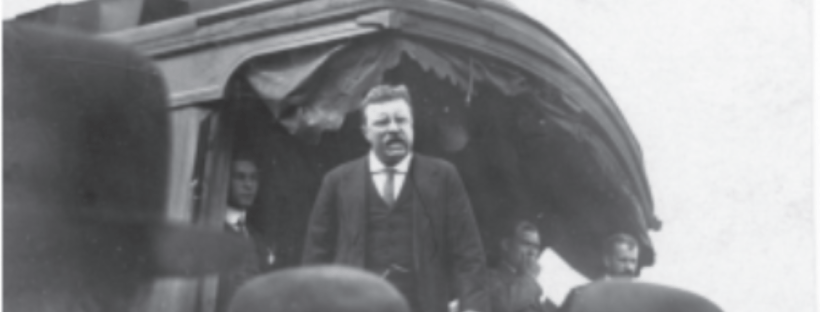
I'm posting here an article I originally wrote for the Kandiyohi County Historical Society newsletter titled, "The Colonel Surrenders in Minnesota" (here's the original .pdf). In it I tell the story of something that, growing up in Montevideo, I was vaguely aware of but knew nothing about. So, turning to the archives I tried to learn more about the only time (as far as I'm aware) a U.S. President visited western Minnesota. The fact that it happened to be Teddy Roosevelt just as he was planning his political comeback should be no surprise. Two years later, in 1912, the state rewarded Roosevelt's efforts with its 12 electoral votes. Radical politics were nothing new to the western part of the state -- in fact, the seventh district's first congressman was a member of the Populist Party and, later, represented by the prohibitionist Andrew J. Volstead. (It's forgotten now, but prohibition was a progressive movement that advocated for women's suffrage and workers' rights among other things). Because of this and the fact that the major rails to the Twin Cities ran through the region, it was not uncommon for satellite cities like Willmar to receive its fair share of speakers. Everyone from William Jennings Bryan (source) to Eugene V. Debs (source) and "Big Bill" Haywood (source) at one point or another visited the city. As I've written elsewhere, this region was later a hotbed for the Farmer-Labor Association. It was Appleton, for example, that Farmer-Labor Party Governor Elmer Benson called home.

“Upon the high and burnished heavens these words: The place to buy hardware stoves and tinsware is at Pierce’s.”

As part of my continuing series digging through the archives of the Internet, I came across the following in the January 30, 1897, edition of The Labor World, a weekly newspaper published in Duluth, MN. The Labor World (which is still around) sought not only to organize the working class within the "Twin Harbors" area of Duluth and Superior, WI, but also reported on local issues. Although I intend to write more about its coverage of Eugene V. Debs' frequent visits to the major port city, I found the following pretty funny. "Roasts the Editor" is an ad in the style of those one occasionally stumbles across that purports to be a Special Report by the magazine's Dentists Hate Him! expert. Maybe more hardware stone companies should follow Mr. "James Wouldbe Riley's" stead. ...