Yesterday I came across a poem and, reading it, obsessed over its simplicity, its horror, its capacity to make the past breathe (or, more appropriately, choke). Although there are many reasons why one may write poetry, one of the highest, I believe, is to aspire for timelessness. "Dulce et Decorum est" by the WWI-era British soldier Wilfred Owen does that.Wilfred Owen A few weeks ago I wrote about the centennial of the assassination of Austrian archduke Franz Ferdinand and how it triggered the events that led to World War One. So, it's in this same spirit I'm posting the work of Owen who, unfortunately, never lived to see much of his poetry published. Sadly, on November 4, 1918, he was killed in the battlefield one week before the Armistice was signed. It's easy to distance oneself from the past, to see epochs not our own in faded colors, the actors as automatons playing their parts to achieve the present. In some ways, I think this habit is a self-defense mechanism, but I'll save that for another article (Does this mean the future will forget my own humanity? But everything I do is so important!). But it's through pieces like this that the snake-trenches across Europe become real. It's scenes like those in the last stanza that the horrors of war become vivid.
“A Butterfly Sleeps on the Temple Bell” by Don Olsen, Midwest Printer
Recently, SMSU English professor and Rural Lit RALLY Advisory Board member David Pichaske was kind enough to send me a copy of Don Olsen's A Butterfly Sleeps on the Temple Bell: A Reminiscence on the Ox Head Press, 1966-2000 (Cross+Roads Press, 2003, 124pgs). Unfortunately, it's out of print but I wanted to say a few words about it since, sadly, nowadays if it can't be found on a Google Search, it doesn't exist. Consider this short review my way of contributing to the western Minnesota paper trail. Don Olsen was a letterpress printer who, prior to retiring in the late-'80s, was a librarian at Southwest Minnesota State University. It was during time that he founded Ox Head Press. In addition to printing cards and broadsides, Olsen published several small pamphlets by an impressive list of writers including Robert Bly, Bill Holm, Ursula K. Le Guin, Pablo Neruda, and Stephen Dunn. Many of these can only be found in university archives (in fact, a Google search for "Ox Head Press" only returns archive catalogs). As the book unfolds, so too does his printer's philosophy, which incidentally was opposed to exactly what's happened to his pieces.

US v. Hendrickson: Sentencing the Addict’s Brain
Recently I've become a staff writer for Columbia University's "Voices in Bioethics." Here's my debut article on US v. Hendrickson, a recent district court sentencing opinion that draws upon neuroscience. In it Judge Bennett cites the work of my boss, Dr. David Eagleman.
The Sharknado of Social Systems
Today the Supreme Court ruled in Hobby Lobby that private corporations can exercise their religious freedom by denying women access to particular forms of birth control. First, I'd like to begin with a few words on religious freedom and the regulation of business. ...
June 28, 1914: “Kills Heir to Throne of Austria”
Today, June 28, 2014, marks the 100th anniversary of the assassination of Archduke Franz Ferdinand. Murdered alongside his wife while traveling through the streets of Sarajevo, it was the catalyst for a series of unfolding events that, one month later, led to Austria-Hungary's declaration of war on Serbia. Within one week, by August 5, 1914, Russia was marching west and Germany was at war with five countries, including France and Britain. As the fabric of Europe frayed, the United States maintained its neutrality. Among historians there is consensus that the shots fired in Sarajevo were the first shots fired in every successive western conflict - the Armistice of the "Great War" set the stage for the spread of fascism, the Spanish Civil War, and World War II. That in turn led to the Cold War and its proxy conflicts within the Middle East and elsewhere. I say this only to highlight the fact that it was an event that set the twentieth century as we know it into motion. Well, this and imperialism.
Three Poems by William Reed Dunroy
Growing up in southwestern Iowa, the poet William Reed Dunroy arrived in Omaha, NE, at the age of twenty. Shuffling between jobs, Dunroy soon enrolled in the University of Nebraska and then became a contributor to The Lincoln Courier. Though he spent only ten years in the state, it was the central focus of his three books of poetry. In fact, his Corn Tassels (1897) was dedicated "To the state I love, NEBRASKA, and to her people." ... From "The Rose in Her Hair": "There's a scarlet rose in my lady's hair/ And her gown in silken white,/ On her cheek there's a delicate rosy glow/ Like the birth of a ruddy light."
Kerouac in Minnesota (January 1949)
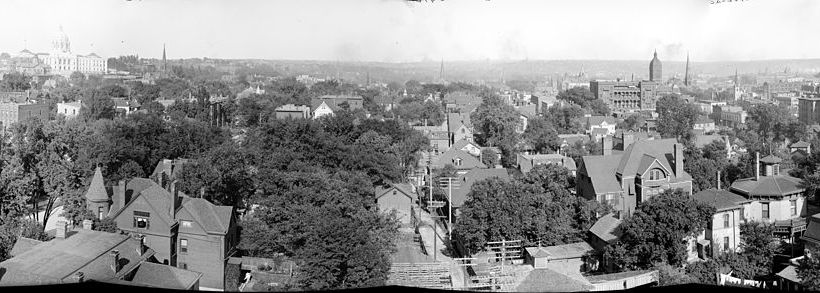
As part of my continuing research into the diary as a genre of literature, I came across the following from Windblown World: The Journals of Jack Kerouac, 1947-1954 (2006). ... "This famous river port still has the old 1870 brick along the waterfront ... now the scene of great fruit and wholesale markets, just as in Kansas City near the downhill Missouri shore. St. Paul is smaller and older and more rickety than Minneapolis, but there is a depressing Pittsburgh-like sootiness about it ... even in joyous snowy winter. Minneapolis is a sprawling dark city shooting off white communities across the montonous flats. The only soulful beauty here is rendered by the Mississippi and also by a hopeless hint of Mille Lacs and the Rainy River country to the North. The people are eastern (of course it's called 'middlewestern') city people; and their corresponding look, talk & absorptions. Blame it on me; I hate almost everything. I would have liked to see Duluth merely because of Sinclair Lewis and Lake Superior."
Sons of Suicide…
Sons of Suicides seldom do well. Characteristically, they find life lacking a certain ZING. They tend to feel more rootless than most, even in a notoriously rootless nation. They are squeamishly incurious about the past and numbly certain about the future to this grisly extent: they suspect that they, too, will probably kill themselves. This … Continue reading Sons of Suicide…
The Writers with a Foot in Two Centuries
For the last several months I’ve been writing a semi-autobiographical novel about growing up in rural Minnesota, running west to the Kerouac School, and back south to Houston. In particular, there’s a focus on the personalities who’ve crossed my path, but it’s also a meditation on the hometown. To quote the poet Bill Holm, it’s true that “We travel to get a better look at home,” but what I see from afar is the woman-witch illusion. The pictures flip back-and-forth, and though I’m grateful for much it’s hard going home – because what am I going back to?
The writer’s nature is “torn between opposing poles of loneliness and gregariousness.”
While reading Thomas Wolfe's You Can't Go Home Again (1940) I came across something I'd like to quote here. As with most of Wolfe's work, it's autobiographical and the following comes from a chapter when he - George Webber - meets Sinclair Lewis - (fictionalized as Lloyd McHarg; link). If you've got the time, I recommend reading Webber and McHarg's whole adventure (it's pretty hilarious).
 Joshua Panduro Preston