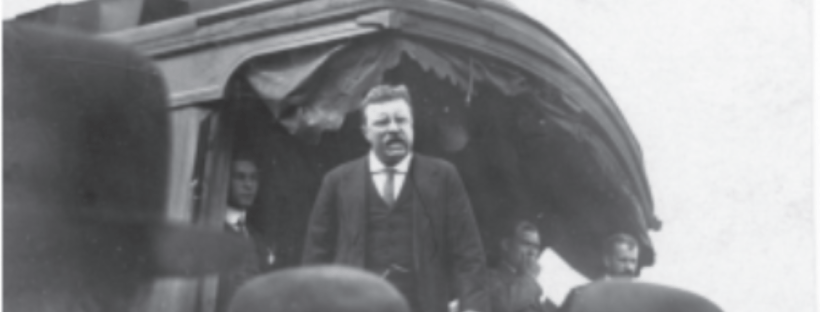
I'm posting here an article I originally wrote for the Kandiyohi County Historical Society newsletter titled, "The Colonel Surrenders in Minnesota" (here's the original .pdf). In it I tell the story of something that, growing up in Montevideo, I was vaguely aware of but knew nothing about. So, turning to the archives I tried to learn more about the only time (as far as I'm aware) a U.S. President visited western Minnesota. The fact that it happened to be Teddy Roosevelt just as he was planning his political comeback should be no surprise. Two years later, in 1912, the state rewarded Roosevelt's efforts with its 12 electoral votes. Radical politics were nothing new to the western part of the state -- in fact, the seventh district's first congressman was a member of the Populist Party and, later, represented by the prohibitionist Andrew J. Volstead. (It's forgotten now, but prohibition was a progressive movement that advocated for women's suffrage and workers' rights among other things). Because of this and the fact that the major rails to the Twin Cities ran through the region, it was not uncommon for satellite cities like Willmar to receive its fair share of speakers. Everyone from William Jennings Bryan (source) to Eugene V. Debs (source) and "Big Bill" Haywood (source) at one point or another visited the city. As I've written elsewhere, this region was later a hotbed for the Farmer-Labor Association. It was Appleton, for example, that Farmer-Labor Party Governor Elmer Benson called home.
Category: History
“Upon the high and burnished heavens these words: The place to buy hardware stoves and tinsware is at Pierce’s.”
As part of my continuing series digging through the archives of the Internet, I came across the following in the January 30, 1897, edition of The Labor World, a weekly newspaper published in Duluth, MN. The Labor World (which is still around) sought not only to organize the working class within the "Twin Harbors" area of Duluth and Superior, WI, but also reported on local issues. Although I intend to write more about its coverage of Eugene V. Debs' frequent visits to the major port city, I found the following pretty funny. "Roasts the Editor" is an ad in the style of those one occasionally stumbles across that purports to be a Special Report by the magazine's Dentists Hate Him! expert. Maybe more hardware stone companies should follow Mr. "James Wouldbe Riley's" stead. ...
“Dulce et Decorum est” by Wilfred Owen
Yesterday I came across a poem and, reading it, obsessed over its simplicity, its horror, its capacity to make the past breathe (or, more appropriately, choke). Although there are many reasons why one may write poetry, one of the highest, I believe, is to aspire for timelessness. "Dulce et Decorum est" by the WWI-era British soldier Wilfred Owen does that.Wilfred Owen A few weeks ago I wrote about the centennial of the assassination of Austrian archduke Franz Ferdinand and how it triggered the events that led to World War One. So, it's in this same spirit I'm posting the work of Owen who, unfortunately, never lived to see much of his poetry published. Sadly, on November 4, 1918, he was killed in the battlefield one week before the Armistice was signed. It's easy to distance oneself from the past, to see epochs not our own in faded colors, the actors as automatons playing their parts to achieve the present. In some ways, I think this habit is a self-defense mechanism, but I'll save that for another article (Does this mean the future will forget my own humanity? But everything I do is so important!). But it's through pieces like this that the snake-trenches across Europe become real. It's scenes like those in the last stanza that the horrors of war become vivid.
“A Butterfly Sleeps on the Temple Bell” by Don Olsen, Midwest Printer
Recently, SMSU English professor and Rural Lit RALLY Advisory Board member David Pichaske was kind enough to send me a copy of Don Olsen's A Butterfly Sleeps on the Temple Bell: A Reminiscence on the Ox Head Press, 1966-2000 (Cross+Roads Press, 2003, 124pgs). Unfortunately, it's out of print but I wanted to say a few words about it since, sadly, nowadays if it can't be found on a Google Search, it doesn't exist. Consider this short review my way of contributing to the western Minnesota paper trail. Don Olsen was a letterpress printer who, prior to retiring in the late-'80s, was a librarian at Southwest Minnesota State University. It was during time that he founded Ox Head Press. In addition to printing cards and broadsides, Olsen published several small pamphlets by an impressive list of writers including Robert Bly, Bill Holm, Ursula K. Le Guin, Pablo Neruda, and Stephen Dunn. Many of these can only be found in university archives (in fact, a Google search for "Ox Head Press" only returns archive catalogs). As the book unfolds, so too does his printer's philosophy, which incidentally was opposed to exactly what's happened to his pieces.
June 28, 1914: “Kills Heir to Throne of Austria”
Today, June 28, 2014, marks the 100th anniversary of the assassination of Archduke Franz Ferdinand. Murdered alongside his wife while traveling through the streets of Sarajevo, it was the catalyst for a series of unfolding events that, one month later, led to Austria-Hungary's declaration of war on Serbia. Within one week, by August 5, 1914, Russia was marching west and Germany was at war with five countries, including France and Britain. As the fabric of Europe frayed, the United States maintained its neutrality. Among historians there is consensus that the shots fired in Sarajevo were the first shots fired in every successive western conflict - the Armistice of the "Great War" set the stage for the spread of fascism, the Spanish Civil War, and World War II. That in turn led to the Cold War and its proxy conflicts within the Middle East and elsewhere. I say this only to highlight the fact that it was an event that set the twentieth century as we know it into motion. Well, this and imperialism.
Three Poems by William Reed Dunroy
Growing up in southwestern Iowa, the poet William Reed Dunroy arrived in Omaha, NE, at the age of twenty. Shuffling between jobs, Dunroy soon enrolled in the University of Nebraska and then became a contributor to The Lincoln Courier. Though he spent only ten years in the state, it was the central focus of his three books of poetry. In fact, his Corn Tassels (1897) was dedicated "To the state I love, NEBRASKA, and to her people." ... From "The Rose in Her Hair": "There's a scarlet rose in my lady's hair/ And her gown in silken white,/ On her cheek there's a delicate rosy glow/ Like the birth of a ruddy light."
Kerouac in Minnesota (January 1949)
As part of my continuing research into the diary as a genre of literature, I came across the following from Windblown World: The Journals of Jack Kerouac, 1947-1954 (2006). ... "This famous river port still has the old 1870 brick along the waterfront ... now the scene of great fruit and wholesale markets, just as in Kansas City near the downhill Missouri shore. St. Paul is smaller and older and more rickety than Minneapolis, but there is a depressing Pittsburgh-like sootiness about it ... even in joyous snowy winter. Minneapolis is a sprawling dark city shooting off white communities across the montonous flats. The only soulful beauty here is rendered by the Mississippi and also by a hopeless hint of Mille Lacs and the Rainy River country to the North. The people are eastern (of course it's called 'middlewestern') city people; and their corresponding look, talk & absorptions. Blame it on me; I hate almost everything. I would have liked to see Duluth merely because of Sinclair Lewis and Lake Superior."
Minnesota on the Death of Darwin: “If one such man arises in a century, that century is fortunate.”
There's a certain charm about small-town newspapers. In the case of those early publications - long before radio, television, the Internet - this was where a community got its news, entertainment, and gossip. This was Facebook. As an archival historian, let me tell you: there's always something waiting to be discovered. So, after realizing that April 18 marked the anniversary of Charles Darwin's death, I thought I'd do a quick search to see how Minnesotans responded. But, first, I'd like to share something published three months earlier, on January 18, 1882. Now, for those unfamiliar with the evolution-creationism debate, the Nye-Ham debacle was their first exposure to the creationist movement. Far from being a contemporary phenomenon, though, that kind of nonsense proliferated before the ink on The Origin of Species was dry. Fortunately, then as now, there was always someone available to mock the church - before there was PZ Myers there was the small-town editor doing newspaper-vaudeville. In the New Ulm Weekly Review, for example, was published the text of a "sermon" by the fictional Reverence Plato Johnson.
Sinclair Lewis and Floyd B. Olson at Breezy Point Lodge
Overlooking Minnesota's Big Pelican Lake is a lodge, a large one, renowned for the visitors it's attracted in its long history. Everyone from actors to governors have stayed there, planting themselves on Breezy Point Resort's long, lumber decks overlooking the lake. It's some of the state's best fishing and also the spot where the author Sinclair Lewis met future-governor Floyd B. Olson for the first, and only, time in 1926. Spending the first half of the year in Kansas City gathering material for his next book in June Lewis headed to Breezy Point to sit down and write. His choice of the northwoods was twofold as it "offered a sophisticated inn where he could get a good meal and drink with Minneapolis' business elite, as well as rustic isolation" (Lingeman 282). When he wasn't writing, Lewis could be found in the lodge doing impressions (as he was known for) or leading guests "in hymn singing around the piano" (Lingeman 285). Many of these he knew by heart since childhood but some came from his time shadowing ministers for what would become Elmer Gantry.
Minnesota’s “Mrs. Peter Oleson is Mrs. Peter Oleson.”
In the early 20th century it was not uncommon for women to identify with their husband's full name and so when women started running for public office it raised an interesting question - how should their names be listed? In Minnesota this question was answered when, in 1922, DNC-member "Mrs. Peter Oleson," Anna Dickie Olesen, announced her candidacy for U.S. Senate. In what would be the state's first direct election of a senator with a full electorate, it was an open question which name would appear on the ballot.