"This anthology is a love letter to my newest hometown, to the rural, and to the small," writes Julie Arhelger in the introduction to Turn Left at Nowhere: A Century of Morris Poetry (2014). Compiled as her capstone project for the University of Minnesota Morris' (UMM) honors program*, Turn Left is a lovely volume of pieces inspired … Continue reading Turn Left at Nowhere: A Century of Morris Poetry
Category: Literature
Drawing a giraffe is the least bizarre thing David Sedaris’ done
Read my review of Joseph Amato’s “Buoyancies” in the Rain Taxi Review
I'm happy to announce that my review of Joseph A. Amato's Buoyancies: A Ballast Master's Log (Crossings & Spoon River Poetry Press, 2014) appears in the latest print edition of The Rain Taxi Review of Books. Don't worry: My article's short. (Plus, if you get bored of my writing, you can literally turn the page and read an interview with Beat poet Diane di Prima).
Garrison Keillor to Robert Bly: “Few poets can re-order our consciousness…”
While going through the Robert Bly Papers at the University of Minnesota, I came across two letters I wanted to share. In the past I've posted pieces from young writers like Oscar Wilde, Aldous Huxley, and Hunter S. Thompson, but the following come from two of the state's most-famous contemporaries. The first excerpt is from Garrison Keillor (age 27) and the other from Bill Holm (age 26). Both letters are dated 1969 and written after Bly gained fame for his literary magazine The Fifties (then The Sixties) and first book of poems, Silence in the Snowy Fields (1963). In 1966, Bly co-founded American Writers Against the Vietnam War and through it staged readings on college campuses across the country, which introduced him to many young poets. This kind of literary activism culminated in his winning the National Book Award for his politically-charged The Light Around the Body (1967). It is hard to overstate the influence Bly had on his contemporaries during the decade. Although both Keillor and and Holm later found their own fame for A Prairie Home Companion and The Music of Failure (1985), respectively, these were still decades away. In fact the two would become good friends with Keillor calling Holm, "The sage ... a colleague of Whitman born one hundred years too late."
On women “mother-naked before long mirrors”: Dorothy Parker’s list of literary cliches to avoid
Recently I bought a copy of The Portable Dorothy Parker (Penguin Books, 1973) and am now reveling in her genius and wit. For those unfamiliar with Parker (1893-1967), she was a writer and columnist whose book reviews frequently appeared in The New Yorker (1927-1933) and Esquire (1957-1962). In the few reviews I've written, I often feel compelled to be … Continue reading On women “mother-naked before long mirrors”: Dorothy Parker’s list of literary cliches to avoid
Midwestern Gothic: Summer 2014 issue
Recently, I subscribed to Midwestern Gothic, a quarterly print literary journal out of Ann Arbor, MI. Before subscribing, I'd stumble occasionally over their work and and was always impressed by what I saw. In a region of the country that many dismiss as "flyover territory," MG is evidence that even if there are planes in the sky, there are feet on the ground and stories in our heads. This is where the next generation of Midwestern writers are publishing. I was excited then when, last month, the Summer 2014 issue arrived in the mail. Of the 37 stories and poems, several stood out that I recommend. These are worth the price of admission alone, and I suggest you check them out.
“A Butterfly Sleeps on the Temple Bell” by Don Olsen, Midwest Printer
Recently, SMSU English professor and Rural Lit RALLY Advisory Board member David Pichaske was kind enough to send me a copy of Don Olsen's A Butterfly Sleeps on the Temple Bell: A Reminiscence on the Ox Head Press, 1966-2000 (Cross+Roads Press, 2003, 124pgs). Unfortunately, it's out of print but I wanted to say a few words about it since, sadly, nowadays if it can't be found on a Google Search, it doesn't exist. Consider this short review my way of contributing to the western Minnesota paper trail. Don Olsen was a letterpress printer who, prior to retiring in the late-'80s, was a librarian at Southwest Minnesota State University. It was during time that he founded Ox Head Press. In addition to printing cards and broadsides, Olsen published several small pamphlets by an impressive list of writers including Robert Bly, Bill Holm, Ursula K. Le Guin, Pablo Neruda, and Stephen Dunn. Many of these can only be found in university archives (in fact, a Google search for "Ox Head Press" only returns archive catalogs). As the book unfolds, so too does his printer's philosophy, which incidentally was opposed to exactly what's happened to his pieces.

Three Poems by William Reed Dunroy
Growing up in southwestern Iowa, the poet William Reed Dunroy arrived in Omaha, NE, at the age of twenty. Shuffling between jobs, Dunroy soon enrolled in the University of Nebraska and then became a contributor to The Lincoln Courier. Though he spent only ten years in the state, it was the central focus of his three books of poetry. In fact, his Corn Tassels (1897) was dedicated "To the state I love, NEBRASKA, and to her people." ... From "The Rose in Her Hair": "There's a scarlet rose in my lady's hair/ And her gown in silken white,/ On her cheek there's a delicate rosy glow/ Like the birth of a ruddy light."
Kerouac in Minnesota (January 1949)
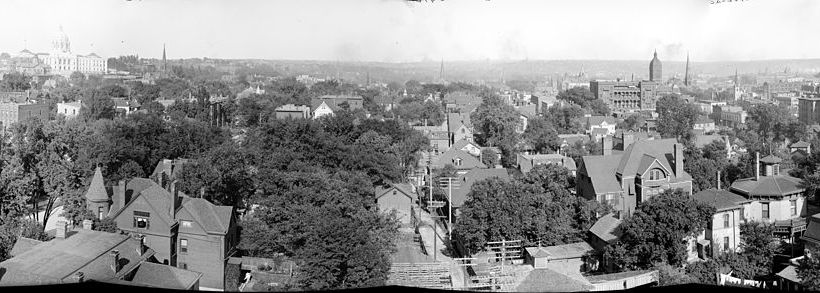
As part of my continuing research into the diary as a genre of literature, I came across the following from Windblown World: The Journals of Jack Kerouac, 1947-1954 (2006). ... "This famous river port still has the old 1870 brick along the waterfront ... now the scene of great fruit and wholesale markets, just as in Kansas City near the downhill Missouri shore. St. Paul is smaller and older and more rickety than Minneapolis, but there is a depressing Pittsburgh-like sootiness about it ... even in joyous snowy winter. Minneapolis is a sprawling dark city shooting off white communities across the montonous flats. The only soulful beauty here is rendered by the Mississippi and also by a hopeless hint of Mille Lacs and the Rainy River country to the North. The people are eastern (of course it's called 'middlewestern') city people; and their corresponding look, talk & absorptions. Blame it on me; I hate almost everything. I would have liked to see Duluth merely because of Sinclair Lewis and Lake Superior."
Sons of Suicide…
Sons of Suicides seldom do well. Characteristically, they find life lacking a certain ZING. They tend to feel more rootless than most, even in a notoriously rootless nation. They are squeamishly incurious about the past and numbly certain about the future to this grisly extent: they suspect that they, too, will probably kill themselves. This … Continue reading Sons of Suicide…