While reading Thomas Wolfe's You Can't Go Home Again (1940) I came across something I'd like to quote here. As with most of Wolfe's work, it's autobiographical and the following comes from a chapter when he - George Webber - meets Sinclair Lewis - (fictionalized as Lloyd McHarg; link). If you've got the time, I recommend reading Webber and McHarg's whole adventure (it's pretty hilarious).
Tag: writing
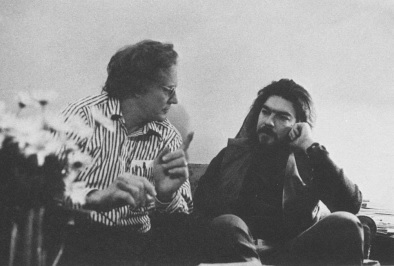
Escaping the Dark Forest: Robert Bly on Deep Image Poetry.
In 1976, winner of the National Book Award and co-founder of Writers Against the Vietnam War, Robert Bly, sat down for an interview with the novelist and literary critic Ekbert Faas. Published in the magazine boundary 2, the pair discuss everything from D.H. Lawrence to Bly's criticism of Allen Ginsberg's Buddhism. (Of the latter, beneath the surface one can feel reverberations from the Merwin-Trungpa "Incident" - or, more accurately, The Great Naropa Poetry Wars). What is particularly interesting, though, is the discussion of Bly's aesthetic. Bly imagines a poetry "in which a great 'flowing' consciousness is present" that is also "aware of [the outer world] all the time." While he abhors the term "Deep Image," this is what he's suggesting and it's become the traditional label of his work. By going deep into the dark woods of one's psyche, coming out the other side aware of oneself and the world, only then can one create art that transcends both. Things like Pop Art fail to find this "adult energy of the unconscious" and as a form makes sense only as artistic "infantilization." ..
Reading Alan Lightman’s “Einstein’s Dreams”
While visiting Half Price Books yesterday, I came across Alan Lightman's Einstein's Dreams (1993). Thumbing through it, I was reminded me of Eagleman's Sum (2009) in that both are collections of witty, dream-like flash fiction tied to a common theme. Where Sum was a meditation on "the afterlives," Einstein's Dreams is an imaginative vision of worlds where, in one, cause does not precede … Continue reading Reading Alan Lightman’s “Einstein’s Dreams”
Robert Sapolsky on Writing and The Popularization of Science
"You know, I'm basically a scientist; I don't really think of myself as a writer," says the neurobiologist and author Robert Sapolsky. "And it's something that I need to discipline myself to do less of because it is much easier for me than doing the science ..." If you aren't familiar with Robert Sapolsky, he … Continue reading Robert Sapolsky on Writing and The Popularization of Science
Four Men in May (Part 2): Hunter S. Thompson, Joshua Preston
This is the follow-up to my last post, "Four Men in May (Part 1): Memory, Oscar Wilde, and Aldous Huxley," where I am posting four letters written by four men in the May before their twenty-third birthday. From Part 1: The title “Four Men in May,” then, is meant to be not only literal but … Continue reading Four Men in May (Part 2): Hunter S. Thompson, Joshua Preston
Four Men in May (Part 1): Memory, Oscar Wilde, and Aldous Huxley
Introduction: The Cold of Winter Is Just A Dream On November 8, 2013, I'll turn twenty-three years old. To many of my "experienced and enlightened" readers this may not seem like much of a milestone, but to me, though, it feels like an awakening. Here's how I see it: while the exact age is arbitrary, … Continue reading Four Men in May (Part 1): Memory, Oscar Wilde, and Aldous Huxley
#8 by Lawrence Ferlinghetti
#8 Lawrence Ferlinghetti Pictures of the Gone World (City Lights Press: 1955) It was a face which darkness could kill in an instant a face as easily hurt by laughter or light 'We think differently at night' she told me once lying back languidly And she would quote Cocteau 'I feel there is an angel in me' … Continue reading #8 by Lawrence Ferlinghetti

On and Off to Houston
Leaving Minneapolis on the morning of July 9, I arrived in Houston, TX, shortly around 4:00am on Thursday, July 11. Spending the night parked, sleeping in the grass, the sounds of the Texas night yielded to the sunrise. I was too groggy, my eyes drooping, to fully appreciate it, but even then I knew that … Continue reading On and Off to Houston
Reading “The Narrow Road to the Deep North” by Matsuo Basho
I was reading the blog of the New York Times Review of Books and came across a particularly interesting article about author and translator Bill Porter ("Finding Zen and Book Contracts in Beijing"). In it the writer talks about Porter's growing popularity in China given not only the burgeoning middle class that is able to … Continue reading Reading “The Narrow Road to the Deep North” by Matsuo Basho
“The Paper Menagerie”, winner of the Nebula Award.
Recently the 2011 Nebula Awards were announced by the Science Fiction and Fantasy Writers of America, which was only brought to my attention because a Doctor Who episode written by Neil Gaiman won the Bradbury Award. While sifting through some of the winners to get a feel for what constitutes some of the top Sci-Fi … Continue reading “The Paper Menagerie”, winner of the Nebula Award.
 Joshua Panduro Preston