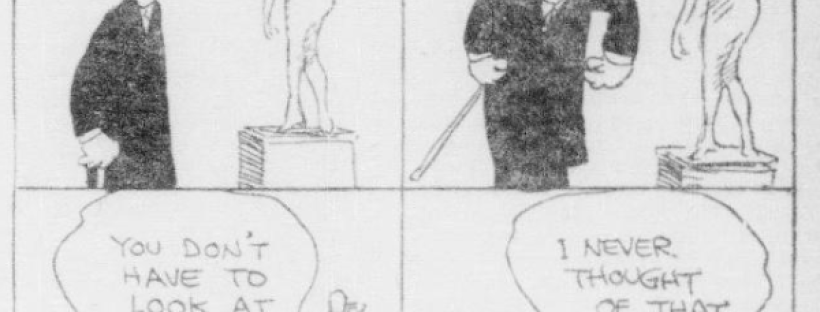
There's a common trope among conservatives that we're living in an era of moral and cultural decay, which is reflected in art and performance -- Elvis Presley! Marilyn Manson! Miley Cyrus! With a nervous sweat on their brow, these moral crusaders call for censorship, suggesting it's the American thing to do. (And, I suppose in some ways it is). But, alas, this kind of outrage is nothing new -- the following comic was printed in Illinois' Rock Island Argus in 1915. Replace the statue with Beyonce and the old white aristocrat with ... the old, white, aristocratic Gov. Mike Huckabee and it's just as relevant a century later. ...
A Review of Alan Lightman’s “Mr. g: A Novel About the Creation” (2012)
Ever since I read Italo Calvino's Invisible Cities (1972) and David Eagleman's Sum (2009), I've been interested in magical realism -- a playful, imaginative curiosity that, lately, has even snuck into my own writing. Shortly after reading their work, it did not take long for me to find Jorge Luis Borges and Alan Lightman (whose Einstein's Dreams I reviewed last year). Lightman's perspective on the genre I've particularly enjoyed given his background as an MIT physicist. So, I was excited when, once again prowling the stacks of Half Priced Books, I came across Mr. g: A Novel About the Creation (Vintage, 2012). ... Mr g is a first-person-except-when-it's-not narrative about God's creation of the universe (or rather a universe). Tolerating the squabbles and input of his Aunt Penelope and Uncle Deva, Mr g introduces space and time to "The Void" (the non-dimensional realm they inhabit), deciding thereafter to create a universe merely to keep himself occupied. Beginning with a few "organizing principles" (natural laws), he spends most of his time fawning over the harmony of the cosmos' as they effectively create themselves. In the book as in nature, it is rules that govern and build not a spirit's hands. Thus emerge stars and the fusion of basic elements to create more, which in clicks of the atomic clock form the richness of planets, solar systems, galaxies. The way Lightman lies out this natural progression -- leading to the emergence of life -- was where I found his prose most engaging. Unfortunately, when this life becomes intelligent, moral, that his writing slipped away. ...
Walking with Paul Gruchow: A Poem
... I'm posting here my submission, which I wrote some time in the fall of 2012 after reading Paul Gruchow's Grass Roots: The Universe of Home (Milkweed Editions, 1995). I was first introduced to his work growing up in Montevideo, MN, which is where he was from, and turned on to his environmental consciousness. If you are interested in Aldo Leopold and "The Land Ethic," you'll enjoy Gruchow's work. Sadly, Gruchow committed suicide in 2004 and so I never had a chance to meet him -- but writers are used to the feeling, I guess. We walk in prose, talk through poems.
The time I gave Michio Kaku’s public presentation (and had him draw a giraffe)
A Letter from Charles Bukowski to Robert Bly
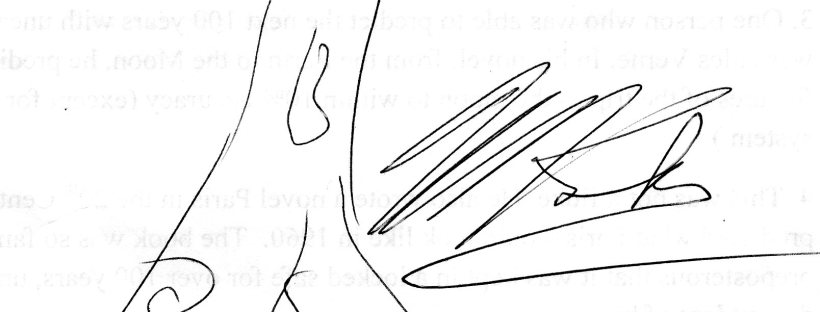
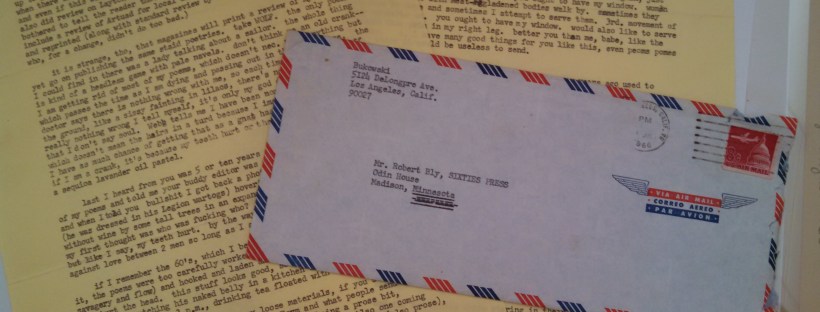
Back in November, I wrote about two letters from Garrison Keillor and Bill Holm I found in the University of Minnesota's Robert Bly Papers. What I didn't note is that I also found one from writer Charles Bukowski. Pulling it out of the stack was a surprise -- though it shouldn't have been given Bly's stature in the literary world at the time -- and so I made a copy of it thinking Buk's may be interested. It's not as big of a literary event as the discovery of Neal Cassady's "Joan Anderson letter," but it does include an unpublished poem. ...
Turn Left at Nowhere: A Century of Morris Poetry
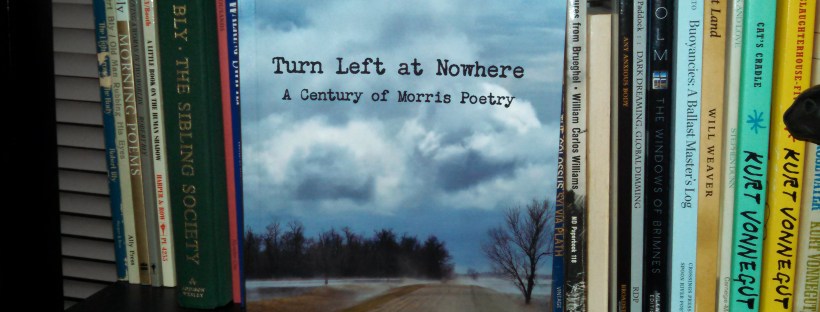
"This anthology is a love letter to my newest hometown, to the rural, and to the small," writes Julie Arhelger in the introduction to Turn Left at Nowhere: A Century of Morris Poetry (2014). Compiled as her capstone project for the University of Minnesota Morris' (UMM) honors program*, Turn Left is a lovely volume of pieces inspired … Continue reading Turn Left at Nowhere: A Century of Morris Poetry
Blogs I’m paying attention to in 2015
This year was the most prolific I've ever been, and has only solidified my desire to be a writer. I'm not trying to be cute or cliche when I say that I can't wait to see what 2015 holds. If the last few years have shown me anything, it is that we dictate our lives, it is not dictated to us. So call me the dictator (?). Of course, no writer can work in total isolation, which is why I'm including here a list of blogs I'll be religiously following in 2015. Whether you're interested in politics, history, or literature, there's a little bit of everything here. In no particular order:
Four Newspaper Illustrations from 1914
A century ago, in 1914, war erupted across Europe following the assassination of Austrian Archduke Franz Ferdinand, a conflict that by its end claimed 37 million casualties worldwide. It was four years of fighting that closed the 19th century and set the 20th into motion. Because its worst horrors remained to be seen (Wilfred Owen's poem "Dulce et Decorum est" captures the disillusion well), there was still hope it'd come to a speedy end. Although this small sample is not representative of every published illustration, political cartoon, and comic, it still provides some insight into the nation's feelings of that decisive year. Here we see doubt over the merits of sustaining a standing army (this being 15 years after the Spanish-American War and the nation's first foray into imperialism). We see as well both doubt and optimism for war -- and finally hope for 1915.
A Column in a Newspaper that Doesn’t Exist
My First Column: We're Living in a Russian Novel ... From where I write, Elmer Springs is a pale glow through winter fog, and as the long arms of night stretch across the road, I feel as though I could be anywhere. In fact, as my little wood stove crackles and growls against the cold, I feel like I'm living in a Russian novel. Having grown up here, I know all about Elmer Springs' generational conflict. I know its class tensions (though in a city whose per capita income is less than the state and national averages, antagonisms exist only between the have-nots and have-lesses). Instead of St. Petersburg and Moscow, we have Minneapolis and St. Paul, cities our little state representative decries for its excesses but insists having the right to visit every two years. Whether any of us are Utopians or Anarchists is as much dependent on the number of ducks in the pond as any coherent political philosophy. Perhaps there's a story here, but I have no ambition to be my generation's Tolstoy. ...
Literary Neuroscience as Rehabilitation? (Or, ‘Prevent Crime; Employ English Majors’)
According to neurolaw, a successful and just legal system will be one that concerns itself with the steps moving forward with the specific brain on trial. If our behavior is influenced by our biology and circumstance, it is irreducibly complex to assess a criminal’s culpability in a way that is both satisfying and scientifically-informed. Instead of comparing and judging the sizes of one’s frontal lobe or another part’s propensity for firing (or not firing) certain chemicals while also factoring in one’s upbringing and the effects social institutions can have on our behavior, our legal system should focus on rehabilitation rather than strict punishment. ...