“American Dystopia”: Read My Review of Claire Sprague’s “It Can Happen Here.”

With the presidential candidacy of Donald J. Trump, it shouldn't surprise anyone that there's been a renewed interest in Sinclair Lewis' novel It Can't Happen Here (1935). For those unfamiliar with it, it's about the rise-to-power of a Depression-era demagogue named Sen. "Buzz" Windrip who becomes president with a campaign based on religious zeal, patriotic fervor, and … Continue reading “American Dystopia”: Read My Review of Claire Sprague’s “It Can Happen Here.”

Translating Sinclair Lewis into English (Two Poems)

As my regular readers know, I write a lot about Sinclair Lewis. For example, there's the anecdote about him drinking with Gov. Floyd B. Olson, his advice on writing, and how those overseas understood his work. I also write about poetry, and recently I published here translations of Norwegian-American poet Julius B. Baumann. Well, here's where … Continue reading Translating Sinclair Lewis into English (Two Poems)

My poetic sequence “The Sun is Leaving the Hill Now” in Literary Orphans

Many months ago I tried my hand at the pantoum form, using lines pulled from "last letters," to produce a series of poems that are simultaneously haunting, anxious, and desperate. I'm proud to say that on April 20 all four were published in Chicago's Literary Orphans magazine (Issue 24: Audrey). Here's the title poem: “The sun … Continue reading My poetic sequence “The Sun is Leaving the Hill Now” in Literary Orphans

John Carter of Minnesota: The “Convict Poet” Who Won His Freedom

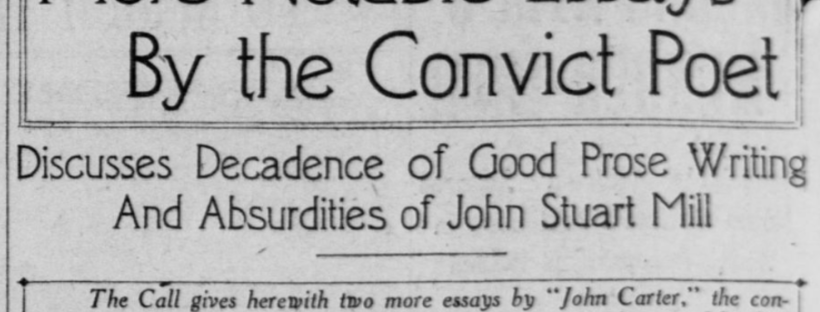
“Only the first ten years matter,” a Minnesota State Prison inmate told John Carter, and "[w]hether or not the first ten years are all that matter, there is no doubt that the first six months are by no means six little drops of time.” It was 1905 and as the 19-year-old Carter listened, he settled … Continue reading John Carter of Minnesota: The “Convict Poet” Who Won His Freedom

My review of Bill Berkson’s “Expect Delays” in Rain Taxi Review

My review of Bill Berkson's latest book of poems, Expect Delays (Coffee House Press, 2014) was published in the Fall 2015 online edition of Rain Taxi Review of Books: There are few poets writing today with the range and talent of Bill Berkson. The author of more than thirty books of poetry, collaborations, and criticism, his latest … Continue reading My review of Bill Berkson’s “Expect Delays” in Rain Taxi Review

Welcome to the Promise Zone: Secretary Julian Castro Visits Minneapolis

On October 30, 2015, U.S. Secretary of Housing and Urban Development Julian Castro participated in a Minneapolis forum on affordable housing. With nothing better to do on a Friday morning, I picked up a notebook and decided to play journalist. Enjoy. I first saw Julian Castro as the nation did, the keynote speaker of the … Continue reading Welcome to the Promise Zone: Secretary Julian Castro Visits Minneapolis

From Main Street to Stockholm: Letters of Sinclair Lewis 1919-1930

Joining Sinclair Lewis on the Trip from Main Street to Stockholm

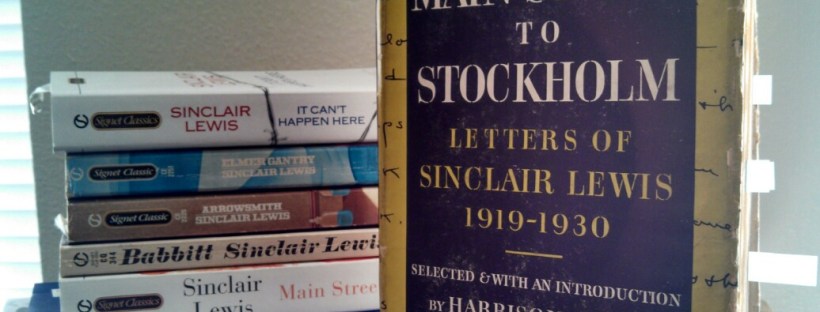
"[D]on't be such a damn fool as ever again to go to work for someone else. Start your own business," the 34-year-old Sinclair Lewis advised his friend Alfred Harcourt. "I'm going to write important books. You can publish them. Now let's go out to your house and start making plans" (p.xi). That business became the publishing house Harcourt, Brace, and Company, and the next year, in 1920, it published the book that made Lewis famous: Main Street. Thus began a decade-long partnership that lasted until Lewis became the first American to the win Nobel Prize in Literature. As the only volume of Lewis' letters, From Main Street to Stockholm was published in 1952, the year after he died, and collects together his correspondence with Harcourt's publishing house. Given their relationship the letters just as often pertain to business as they do Lewis' European travels and the politics of the literary world. While the reader may not close the book with a richer understanding of Lewis' psychology, they will have witnessed an iconoclast at work. Through these letters one follows Lewis through the "Big Five" and the public's response, from Main Street (1920) being declared the most monumental book of the century to Boston's District Attorney banning Elmer Gantry (1927) from the city.

“Made while under fire”: Elijah E. Edwards’ Civil War sketches

Before there were cameras to document warfare, there were sketchbooks. So imagine then sketching a battlefield and, as smoke filled the air and bullets zipped past, trying to keep your pencil straight. This, though, was the experience of many artists, including Elijah Evan Edwards (1831-1915), who served as chaplain of the 7th Minnesota Infantry during the Civil War (1864-1865). The Minnesota Historical Society has three volumes of Edwards' journals, including a 1910 typescript he wrote synthesizing his pocket diaries from the war. In it he discusses daily camp life, the people he met, different battles, and so on. Besides being an invaluable, firsthand account of the Civil War, what makes the text rich is its being accompanied by several dozen sketches made from "hasty outlines finished from memory when I had leisure." "This is especially true of the battle scenes," he added, "since I had during the critical moments of the conflict neither leisure nor opportunity to make sketches." (p.1). It's these that distinguish Edwards' written account from others.