Reading “Self Published Kindling: Memoirs of a Homeless Bookstore Owner” by Mik Everett

As part of a project I'm doing on the state of contemporary writing, author Mik Everett mailed me a copy of her book Self Published Kindling: Memoirs of a Homeless Bookstore Owner (2013). After reading it, I'm excited for what our generation has to offer the literary world. As Everett so clearly illustrates: we're one of dreamers and as we set out, so much of what we have to say will be about how we maintained this spirit while navigating the world given to us by our parents. (And if you've paid any attention to the news at all, it's not a great one). Written while living out of a broken-down RV in a Wal-Mart parking lot, Self Published Kindling is about Everett's experience running a Longmont, Colorado, bookstore that stocked exclusively self-published and regional books. Though the first store of its kind in the nation, Everett quickly discovers that few writers read and even fewer readers want books you can't find in a Barnes and Noble. She tries to mitigate this through author readings and art crawls, but everyone who comes in leaves empty-handed. Soon she and her partner, John, conclude, "Everybody's just here to pretend they support art" (48). If you're an artist who's ever tried to sell their work, you know exactly what that means.

Holding Robert Bly’s Diaries

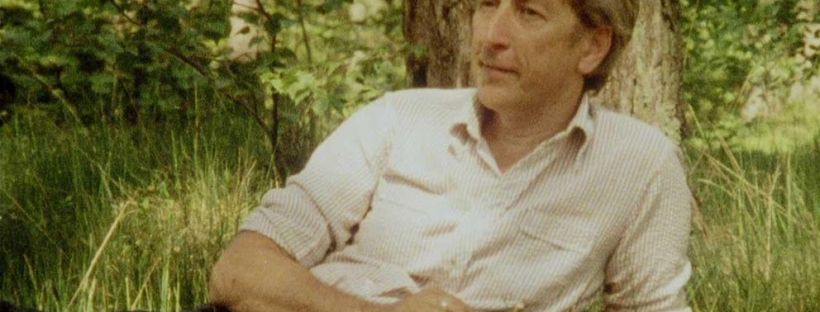
Going through Bly's diaries and correspondence spanning his entire life, I felt empowered watching this writer grow, discovering that the youthful doubts I harbor are doubts he harbored, too. It felt validating. (I don't expect anyone but the writers in the audience to understand what I mean by this). Sometimes I'd even stumble across lines that, in variation, have appeared in my own diary ...

Writing advice from Bly, Merwin, and Pound: “It’s always good to learn another language and translate”

A few years ago I corresponded with poet Robert Bly, and I asked him what advice he had for young writers. In his late-eighties and ill, I did not expect an answer, and so I was surprised (even more: nervous) when a few weeks later a familiar cream-colored envelope arrived. Opening it, he'd written, "You're wondering what … Continue reading Writing advice from Bly, Merwin, and Pound: “It’s always good to learn another language and translate”

Reading Rana Dasgupta’s “Tokyo Cancelled” (2005).

After being recommended to me by a friend, I just finished reading Rana Dasgupta's Tokyo Cancelled (Black Cat Press, 2005). Checking out the reviews online, though, there seems to be contention as to whether it fits the standard definition of "magical realism" or (something I've only now discovered) "irrealism." Of course, a distinction like this means nothing to most … Continue reading Reading Rana Dasgupta’s “Tokyo Cancelled” (2005).

A Review of Alan Lightman’s “Mr. g: A Novel About the Creation” (2012)

Ever since I read Italo Calvino's Invisible Cities (1972) and David Eagleman's Sum (2009), I've been interested in magical realism -- a playful, imaginative curiosity that, lately, has even snuck into my own writing. Shortly after reading their work, it did not take long for me to find Jorge Luis Borges and Alan Lightman (whose Einstein's Dreams I reviewed last year). Lightman's perspective on the genre I've particularly enjoyed given his background as an MIT physicist. So, I was excited when, once again prowling the stacks of Half Priced Books, I came across Mr. g: A Novel About the Creation (Vintage, 2012). ... Mr g is a first-person-except-when-it's-not narrative about God's creation of the universe (or rather a universe). Tolerating the squabbles and input of his Aunt Penelope and Uncle Deva, Mr g introduces space and time to "The Void" (the non-dimensional realm they inhabit), deciding thereafter to create a universe merely to keep himself occupied. Beginning with a few "organizing principles" (natural laws), he spends most of his time fawning over the harmony of the cosmos' as they effectively create themselves. In the book as in nature, it is rules that govern and build not a spirit's hands. Thus emerge stars and the fusion of basic elements to create more, which in clicks of the atomic clock form the richness of planets, solar systems, galaxies. The way Lightman lies out this natural progression -- leading to the emergence of life -- was where I found his prose most engaging. Unfortunately, when this life becomes intelligent, moral, that his writing slipped away. ...

A Letter from Charles Bukowski to Robert Bly

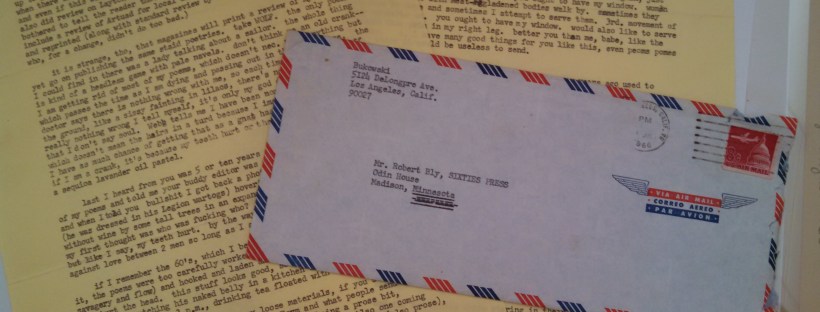
Back in November, I wrote about two letters from Garrison Keillor and Bill Holm I found in the University of Minnesota's Robert Bly Papers. What I didn't note is that I also found one from writer Charles Bukowski. Pulling it out of the stack was a surprise -- though it shouldn't have been given Bly's stature in the literary world at the time -- and so I made a copy of it thinking Buk's may be interested. It's not as big of a literary event as the discovery of Neal Cassady's "Joan Anderson letter," but it does include an unpublished poem. ...