Tag: poetry
Read my review of Joseph Amato’s “Buoyancies” in the Rain Taxi Review
I'm happy to announce that my review of Joseph A. Amato's Buoyancies: A Ballast Master's Log (Crossings & Spoon River Poetry Press, 2014) appears in the latest print edition of The Rain Taxi Review of Books. Don't worry: My article's short. (Plus, if you get bored of my writing, you can literally turn the page and read an interview with Beat poet Diane di Prima).

Garrison Keillor to Robert Bly: “Few poets can re-order our consciousness…”
While going through the Robert Bly Papers at the University of Minnesota, I came across two letters I wanted to share. In the past I've posted pieces from young writers like Oscar Wilde, Aldous Huxley, and Hunter S. Thompson, but the following come from two of the state's most-famous contemporaries. The first excerpt is from Garrison Keillor (age 27) and the other from Bill Holm (age 26). Both letters are dated 1969 and written after Bly gained fame for his literary magazine The Fifties (then The Sixties) and first book of poems, Silence in the Snowy Fields (1963). In 1966, Bly co-founded American Writers Against the Vietnam War and through it staged readings on college campuses across the country, which introduced him to many young poets. This kind of literary activism culminated in his winning the National Book Award for his politically-charged The Light Around the Body (1967). It is hard to overstate the influence Bly had on his contemporaries during the decade. Although both Keillor and and Holm later found their own fame for A Prairie Home Companion and The Music of Failure (1985), respectively, these were still decades away. In fact the two would become good friends with Keillor calling Holm, "The sage ... a colleague of Whitman born one hundred years too late."
“Upon the high and burnished heavens these words: The place to buy hardware stoves and tinsware is at Pierce’s.”
As part of my continuing series digging through the archives of the Internet, I came across the following in the January 30, 1897, edition of The Labor World, a weekly newspaper published in Duluth, MN. The Labor World (which is still around) sought not only to organize the working class within the "Twin Harbors" area of Duluth and Superior, WI, but also reported on local issues. Although I intend to write more about its coverage of Eugene V. Debs' frequent visits to the major port city, I found the following pretty funny. "Roasts the Editor" is an ad in the style of those one occasionally stumbles across that purports to be a Special Report by the magazine's Dentists Hate Him! expert. Maybe more hardware stone companies should follow Mr. "James Wouldbe Riley's" stead. ...
“Dulce et Decorum est” by Wilfred Owen
Yesterday I came across a poem and, reading it, obsessed over its simplicity, its horror, its capacity to make the past breathe (or, more appropriately, choke). Although there are many reasons why one may write poetry, one of the highest, I believe, is to aspire for timelessness. "Dulce et Decorum est" by the WWI-era British soldier Wilfred Owen does that.Wilfred Owen A few weeks ago I wrote about the centennial of the assassination of Austrian archduke Franz Ferdinand and how it triggered the events that led to World War One. So, it's in this same spirit I'm posting the work of Owen who, unfortunately, never lived to see much of his poetry published. Sadly, on November 4, 1918, he was killed in the battlefield one week before the Armistice was signed. It's easy to distance oneself from the past, to see epochs not our own in faded colors, the actors as automatons playing their parts to achieve the present. In some ways, I think this habit is a self-defense mechanism, but I'll save that for another article (Does this mean the future will forget my own humanity? But everything I do is so important!). But it's through pieces like this that the snake-trenches across Europe become real. It's scenes like those in the last stanza that the horrors of war become vivid.
Three Poems by William Reed Dunroy
Growing up in southwestern Iowa, the poet William Reed Dunroy arrived in Omaha, NE, at the age of twenty. Shuffling between jobs, Dunroy soon enrolled in the University of Nebraska and then became a contributor to The Lincoln Courier. Though he spent only ten years in the state, it was the central focus of his three books of poetry. In fact, his Corn Tassels (1897) was dedicated "To the state I love, NEBRASKA, and to her people." ... From "The Rose in Her Hair": "There's a scarlet rose in my lady's hair/ And her gown in silken white,/ On her cheek there's a delicate rosy glow/ Like the birth of a ruddy light."
The writer’s nature is “torn between opposing poles of loneliness and gregariousness.”
While reading Thomas Wolfe's You Can't Go Home Again (1940) I came across something I'd like to quote here. As with most of Wolfe's work, it's autobiographical and the following comes from a chapter when he - George Webber - meets Sinclair Lewis - (fictionalized as Lloyd McHarg; link). If you've got the time, I recommend reading Webber and McHarg's whole adventure (it's pretty hilarious).
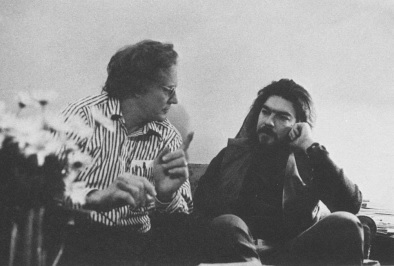
Escaping the Dark Forest: Robert Bly on Deep Image Poetry.
In 1976, winner of the National Book Award and co-founder of Writers Against the Vietnam War, Robert Bly, sat down for an interview with the novelist and literary critic Ekbert Faas. Published in the magazine boundary 2, the pair discuss everything from D.H. Lawrence to Bly's criticism of Allen Ginsberg's Buddhism. (Of the latter, beneath the surface one can feel reverberations from the Merwin-Trungpa "Incident" - or, more accurately, The Great Naropa Poetry Wars). What is particularly interesting, though, is the discussion of Bly's aesthetic. Bly imagines a poetry "in which a great 'flowing' consciousness is present" that is also "aware of [the outer world] all the time." While he abhors the term "Deep Image," this is what he's suggesting and it's become the traditional label of his work. By going deep into the dark woods of one's psyche, coming out the other side aware of oneself and the world, only then can one create art that transcends both. Things like Pop Art fail to find this "adult energy of the unconscious" and as a form makes sense only as artistic "infantilization." ..

“The Basketball Diaries” by Jim Carroll
First published in 1978, The Basketball Diaries by Jim Carroll is a slightly-fictionalized account of growing up in New York City. Spanning the Fall of 1963 (when he was 12) to the Summer 1966, the reader follows Carroll as he wanders the streets, shoots heroin, and makes love. Although much has been made of his drug and sex life, which in fairness is most of the book, what's often overlooked are the themes that slowly rise from his experiences. Rather than being merely "the classic about growing up hip on New York's mean streets" (the person who wrote that should be imprisoned) it's an account of maturity - sexual, emotional, and even political. As these all run parallel, they soon converge at a point that transcends any one person's experiences: we are our lost innocence.
#8 by Lawrence Ferlinghetti
#8 Lawrence Ferlinghetti Pictures of the Gone World (City Lights Press: 1955) It was a face which darkness could kill in an instant a face as easily hurt by laughter or light 'We think differently at night' she told me once lying back languidly And she would quote Cocteau 'I feel there is an angel in me' … Continue reading #8 by Lawrence Ferlinghetti
 Joshua Panduro Preston