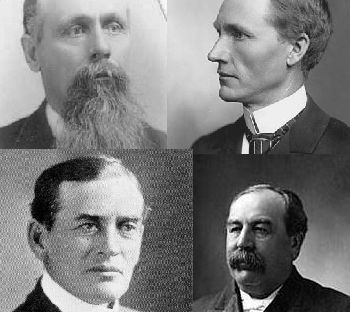
As I've written elsewhere, given my time at the Initiative, I've developed an interest in Big Data analysis and how this methodology can be applied to history ("the digital humanities"). Specifically, as collections become digitized, the sheer volume of resources ought to inspire historians to find new ways to engage and manage information. While the result will only be as good as the analysis, it has the potential to reveal trends that otherwise may be implied but not obvious. The following tracks the state newspaper mentions of particular keywords -- in this case, names -- of four Minnesota governors: David M. Clough, John Lind, Samuel R. Van Sant, and John A. Johnson. For example, every instance in which "John" and "Lind" appear within five words of one another on a Minnesota newspaper page, that page is counted. Searching for variations of how these individuals were addressed (such as "Governor Van Sant" rather than "Samuel Van Sant" or "S.R. Van Sant") yield different counts but the overall trends are the same.
Tag: politics
The Digital Humanities and Word Clouds
Ever since I joined the Initiative on Neuroscience and Law, I've had a growing interest in big data analysis. With so much information being digitized -- whether it's criminal records, government documents, or historical archives -- researchers can engage with old resources in new ways and ask questions on scales previously unimaginable. Though I'm not too vocal about it here (yet), right now I'm working to apply what I've learned at the Initiative to the Library of Congress' "Chronicling America" archives. This crossing of fields, for those who are curious, is called the "Digital Humanities." (If you'd like to know more, I suggest checking out the historian Dan Cohen's blog. Fred Gibbs also has a helpful introduction to historical data analysis here). I won't reveal any of my graphics here (I'm saving them for a future post), but here's an example of the Digital Humanities that everyone's familiar with: Word clouds. Technically, these were possible before the digitization of famous works, but it's the kind of work that required slave labor teaching assistants. The following I put together in a few minutes using Project Gutenberg and Wordle.
How not to report the news: Food stamp fraud edition
After my father died, growing up, my family depended on entitlement programs like WIC, free school lunch, and the Supplemental Nutrition Assistance Program (SNAP). Hardly the mystical "Welfare Queens" conservatives imagine, we were just a low-income, single-parent household. You know, like a lot of families who rely upon these programs. By not worrying about where my … Continue reading How not to report the news: Food stamp fraud edition
The Time’s Don’t Change: “The 98 Per Cent Have Some Rights Entitled to Respect.”
It's time for some Minnesota trivia: Who said this?We have had to oppose the swaggering insolence and the millions of the war profiteers and the low moral endeavor politicians made by the froth of the war.... We needed success to call a halt to the wild orgie of Wall street legislation which the politicians thought … Continue reading The Time’s Don’t Change: “The 98 Per Cent Have Some Rights Entitled to Respect.”
“The Basketball Diaries” by Jim Carroll
First published in 1978, The Basketball Diaries by Jim Carroll is a slightly-fictionalized account of growing up in New York City. Spanning the Fall of 1963 (when he was 12) to the Summer 1966, the reader follows Carroll as he wanders the streets, shoots heroin, and makes love. Although much has been made of his drug and sex life, which in fairness is most of the book, what's often overlooked are the themes that slowly rise from his experiences. Rather than being merely "the classic about growing up hip on New York's mean streets" (the person who wrote that should be imprisoned) it's an account of maturity - sexual, emotional, and even political. As these all run parallel, they soon converge at a point that transcends any one person's experiences: we are our lost innocence.
Howard Zinn & Noam Chomsky on “Is There Hope in This Desperate Time?”
I know some of my readers won't be particularly interested in this, but I thought I'd share it anyway. Recorded in September 2004 to raise funds for Spare Change, a street newspaper, the video brings together two of the top public intellectuals of our time, Noam Chomsky and Howard Zinn, to discuss whether there is "hope … Continue reading Howard Zinn & Noam Chomsky on “Is There Hope in This Desperate Time?”
Burke, Price, Franklin and Farting
To the layman (and by “layman” I of course mean the “laymen of political theory”) Richard Price is known only for the fact that his cries for revolution in England during the late-18th century were the subject of criticism in Edmund Burke’s infamous Reflections on the Revolution in France (1790). Where Price was making the … Continue reading Burke, Price, Franklin and Farting
The Common Man Partisan
Morris Student DFL Column If you are like most youth, “politics” is something that happens only once every four years when there is a George W. Bush or Barack Obama at the top of the ticket. Besides that, “politics” is that thing that only the most hardcore of partisans pay attention to – something left … Continue reading The Common Man Partisan
What if the Tea Party was black?
A friend of mine from St. John's brought this article ("Imagine if the Tea Party was Black") to my attention and I'm glad he did - I believe the author, Tim Wise, is absolutely right in his assertions and their implications; we may think that we have come a long way following the election of … Continue reading What if the Tea Party was black?
Conscience Over Pragmatism
Besides writing for the campus newspaper at the University of Minnesota-Morris, The University Register, I also occasionally contribute a column for the Morris Student DFL when I can't delegate the task to someone else in the organization. It was published on April 15, 2010. DFL COLUMN - April 15, 2010 By Joshua P. Preston While … Continue reading Conscience Over Pragmatism