Tag: University of Minnesota Morris
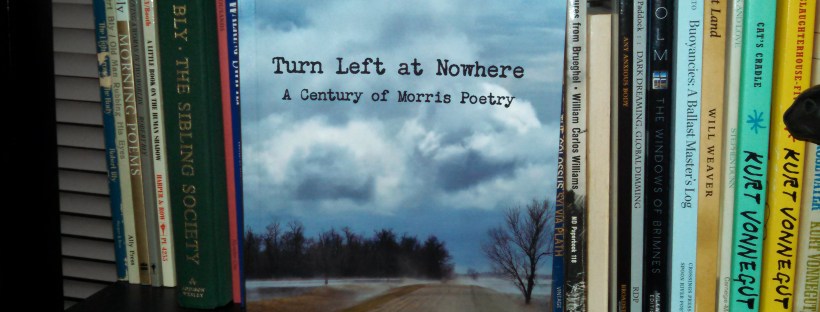
Turn Left at Nowhere: A Century of Morris Poetry
"This anthology is a love letter to my newest hometown, to the rural, and to the small," writes Julie Arhelger in the introduction to Turn Left at Nowhere: A Century of Morris Poetry (2014). Compiled as her capstone project for the University of Minnesota Morris' (UMM) honors program*, Turn Left is a lovely volume of pieces inspired … Continue reading Turn Left at Nowhere: A Century of Morris Poetry

Blogs I’m paying attention to in 2015
This year was the most prolific I've ever been, and has only solidified my desire to be a writer. I'm not trying to be cute or cliche when I say that I can't wait to see what 2015 holds. If the last few years have shown me anything, it is that we dictate our lives, it is not dictated to us. So call me the dictator (?). Of course, no writer can work in total isolation, which is why I'm including here a list of blogs I'll be religiously following in 2015. Whether you're interested in politics, history, or literature, there's a little bit of everything here. In no particular order:

The Digital Humanities and Word Clouds
Ever since I joined the Initiative on Neuroscience and Law, I've had a growing interest in big data analysis. With so much information being digitized -- whether it's criminal records, government documents, or historical archives -- researchers can engage with old resources in new ways and ask questions on scales previously unimaginable. Though I'm not too vocal about it here (yet), right now I'm working to apply what I've learned at the Initiative to the Library of Congress' "Chronicling America" archives. This crossing of fields, for those who are curious, is called the "Digital Humanities." (If you'd like to know more, I suggest checking out the historian Dan Cohen's blog. Fred Gibbs also has a helpful introduction to historical data analysis here). I won't reveal any of my graphics here (I'm saving them for a future post), but here's an example of the Digital Humanities that everyone's familiar with: Word clouds. Technically, these were possible before the digitization of famous works, but it's the kind of work that required slave labor teaching assistants. The following I put together in a few minutes using Project Gutenberg and Wordle.
Be the Change You Want to See
Morris Student DFL Column On the International Day of Peace I had the great fortune to speak with several students about the importance of registering to vote (after all, peace has never grown from reticence!) Perhaps using more clichés than was necessary – It’s a rare right to exercise in this world; privilege; privilege; privilege … Continue reading Be the Change You Want to See
The Common Man Partisan
Morris Student DFL Column If you are like most youth, “politics” is something that happens only once every four years when there is a George W. Bush or Barack Obama at the top of the ticket. Besides that, “politics” is that thing that only the most hardcore of partisans pay attention to – something left … Continue reading The Common Man Partisan
UR: Sec. Ritchie Asks Students to Register to Vote
This is an article I wrote for the campus newspaper at the University of Minnesota-Morris, The University Register, about Minnesota Secretary of State Mark Ritchie's visit to the campus to discuss voter registration for the August 10 primary. This article was published on April 28, 2010. SEC. RITCHIE ASKS STUDENTS TO REGISTER TO VOTE By … Continue reading UR: Sec. Ritchie Asks Students to Register to Vote
 Joshua Panduro Preston