A few years ago I corresponded with poet Robert Bly, and I asked him what advice he had for young writers. In his late-eighties and ill, I did not expect an answer, and so I was surprised (even more: nervous) when a few weeks later a familiar cream-colored envelope arrived. Opening it, he'd written, "You're wondering what … Continue reading Writing advice from Bly, Merwin, and Pound: “It’s always good to learn another language and translate”
Read my review of “Ivy League Bohemians” on Empty Mirror
As part of our "research" for an upcoming trip, my friend Elliot and I decided to read Alison Winfield Burns' Ivy League Bohemians (2015), a self-published memoir of her time at the Jack Kerouac School of Disembodied Poetics. While failing to deliver, it is a book I think ought to be on every Beat aficionados' radar … Continue reading Read my review of “Ivy League Bohemians” on Empty Mirror
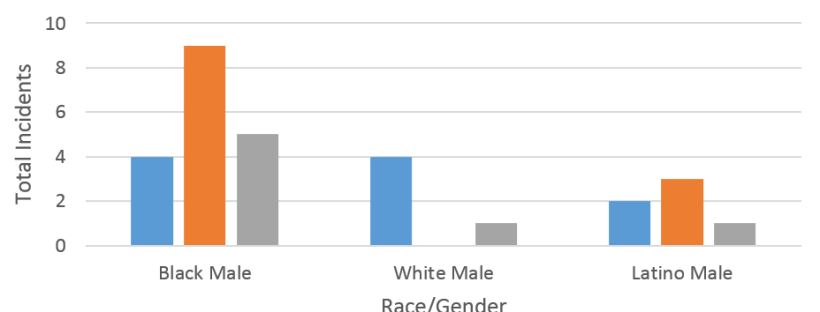
The racial breakdown of police involved shootings in Dallas, TX
Following the fatal shooting of Michael Brown in Ferguson, MO, there was renewed focus on the prevalence of police shootings in the United States. Yet, as was discovered by The Washington Post and scholars everywhere: No federal agency keeps track of this information, and everything the FBI does maintain is limited to raw numbers on "justifiable homicides." … Continue reading The racial breakdown of police involved shootings in Dallas, TX
The importance of writing a court opinion well
This month Texas Monthly published an interview with retiring Texas criminal court judge Cathy Cochran, and in it she discusses the top judiciary reforms of the last twenty years. These include the increased use of DNA evidence, compensation for the wrongfully incarcerated, and policies to curtail false eyewitness identifications. All of these are surprisingly progressive reforms … Continue reading The importance of writing a court opinion well
Neuromodulation, Or “Every Science Lab Needs a Philosopher”
If a fundamental question in neurolaw is how the legal system should move forward with the specific brain on trial, then the major role neuroscience can play in the courtroom is in the sentencing process. In fact, after identifying the biology that may have predisposed an individual to criminal behavior, attention must be paid to how sentencing - the rehabilitation process - can effectively be carried out. For example, if it was a malformed frontal lobe that unfairly led an individual to give in to an irresistable impulse, neuroscience plays the dual role of identifying this malformity and how best to correct it. ...
Reading Rana Dasgupta’s “Tokyo Cancelled” (2005).
After being recommended to me by a friend, I just finished reading Rana Dasgupta's Tokyo Cancelled (Black Cat Press, 2005). Checking out the reviews online, though, there seems to be contention as to whether it fits the standard definition of "magical realism" or (something I've only now discovered) "irrealism." Of course, a distinction like this means nothing to most … Continue reading Reading Rana Dasgupta’s “Tokyo Cancelled” (2005).
A Letter on “Hope.”
Recently on Fiverr, I was asked to write a letter, which being a (militant) advocate for written-correspondence I was glad to comply. The only problem, though, was that I was asked to talk about "Hope." Where does one even begin? Deciding not to focus on my own experiences, I wanted to investigate what Hope actually is -- and I wanted be more practical and philosophical than merely (and often unfulfillingly) poetic. You'll find here no allusions to spring or sunrise. For such a nebulous but necessary emotion, I think it requires more seriousness than that.
Writing Advice from Sinclair Lewis on His 130th Birthday
On this day in 1885, writer Sinclair Lewis was born. Author of Main Street (1920), Babbitt (1922), and Elmer Gantry (1927), Lewis was the first American to win the Nobel Prize for Literature (1930). So to celebrate his 130th birthday, I'm sharing his writing advice from when he taught briefly at the University of Wisconsin (1940) and University of Minnesota (1942). ...
The natural sciences can inform rather than dictate our public policy
In an article titled "Can Neuroscience Challenge Roe v. Wade?" William Egginton, professor in the Humanities at John Hopkins University, cautions us to be careful in how we use the natural sciences to shape public policy. In this case, abortion rights. Egginton writes about attorney Rick Hearn's suits against Idaho's Pain-Capable Unborn Child Protection Act "and others like it that cite neuroscientific findings of pain sentience on the part of fetuses as a basis for prohibiting abortions even prior to viability." The reason for this is because Hearn believes that the government is using results from the natural sciences "as a basis for expanding or contracting the rights of its citizens." The logic goes like this: if it can be proven that fetuses are capable of pain then they are conscious and thus a person deserving of their full rights under the constitution. This clearly has political overtones. ...
On Sarah Palin’s Spoken-Word Performance at the Iowa Freedom Summit
Recently speaking at the Iowa Freedom Summit, former Alaskan governor Sarah Palin gave a speech that, as one writer for the conservative National Review wrote, was "meandering and often bizarre." Satirist Jon Stewart had a field day with this, of course, comparing Palin's speech to those Lincoln commercials where Matthew McConaughey drives around making sounds. This criticism, though, is unfair. I mean, sure, if you're a philistine everything she said was stupid, babbling nonsense (that's because you're a philistine), but just look at how Palin's speech has been excerpted/butchered by the mainstream media (note the formatting) ...