On this day in 1885, writer Sinclair Lewis was born. Author of Main Street (1920), Babbitt (1922), and Elmer Gantry (1927), Lewis was the first American to win the Nobel Prize for Literature (1930). So to celebrate his 130th birthday, I'm sharing his writing advice from when he taught briefly at the University of Wisconsin (1940) and University of Minnesota (1942). ...
Tag: writing
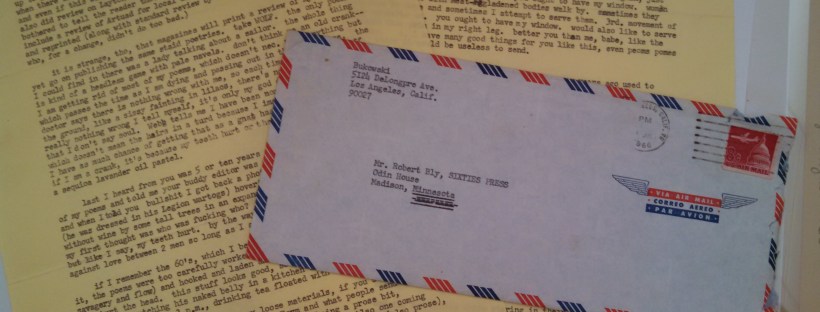
A Letter from Charles Bukowski to Robert Bly
Back in November, I wrote about two letters from Garrison Keillor and Bill Holm I found in the University of Minnesota's Robert Bly Papers. What I didn't note is that I also found one from writer Charles Bukowski. Pulling it out of the stack was a surprise -- though it shouldn't have been given Bly's stature in the literary world at the time -- and so I made a copy of it thinking Buk's may be interested. It's not as big of a literary event as the discovery of Neal Cassady's "Joan Anderson letter," but it does include an unpublished poem. ...
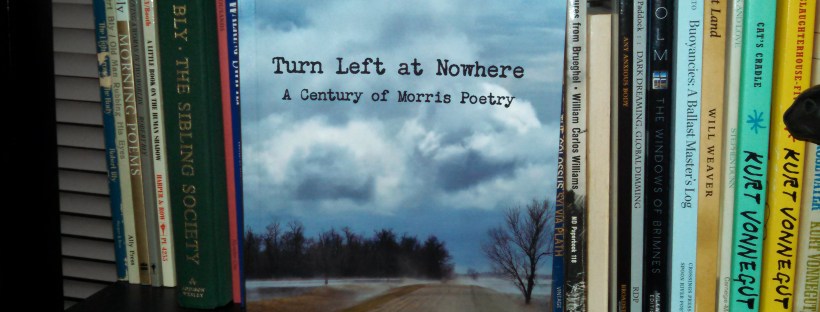
Turn Left at Nowhere: A Century of Morris Poetry
"This anthology is a love letter to my newest hometown, to the rural, and to the small," writes Julie Arhelger in the introduction to Turn Left at Nowhere: A Century of Morris Poetry (2014). Compiled as her capstone project for the University of Minnesota Morris' (UMM) honors program*, Turn Left is a lovely volume of pieces inspired … Continue reading Turn Left at Nowhere: A Century of Morris Poetry
Blogs I’m paying attention to in 2015
This year was the most prolific I've ever been, and has only solidified my desire to be a writer. I'm not trying to be cute or cliche when I say that I can't wait to see what 2015 holds. If the last few years have shown me anything, it is that we dictate our lives, it is not dictated to us. So call me the dictator (?). Of course, no writer can work in total isolation, which is why I'm including here a list of blogs I'll be religiously following in 2015. Whether you're interested in politics, history, or literature, there's a little bit of everything here. In no particular order:
Drawing a giraffe is the least bizarre thing David Sedaris’ done
Read my review of Joseph Amato’s “Buoyancies” in the Rain Taxi Review
I'm happy to announce that my review of Joseph A. Amato's Buoyancies: A Ballast Master's Log (Crossings & Spoon River Poetry Press, 2014) appears in the latest print edition of The Rain Taxi Review of Books. Don't worry: My article's short. (Plus, if you get bored of my writing, you can literally turn the page and read an interview with Beat poet Diane di Prima).
Garrison Keillor to Robert Bly: “Few poets can re-order our consciousness…”
While going through the Robert Bly Papers at the University of Minnesota, I came across two letters I wanted to share. In the past I've posted pieces from young writers like Oscar Wilde, Aldous Huxley, and Hunter S. Thompson, but the following come from two of the state's most-famous contemporaries. The first excerpt is from Garrison Keillor (age 27) and the other from Bill Holm (age 26). Both letters are dated 1969 and written after Bly gained fame for his literary magazine The Fifties (then The Sixties) and first book of poems, Silence in the Snowy Fields (1963). In 1966, Bly co-founded American Writers Against the Vietnam War and through it staged readings on college campuses across the country, which introduced him to many young poets. This kind of literary activism culminated in his winning the National Book Award for his politically-charged The Light Around the Body (1967). It is hard to overstate the influence Bly had on his contemporaries during the decade. Although both Keillor and and Holm later found their own fame for A Prairie Home Companion and The Music of Failure (1985), respectively, these were still decades away. In fact the two would become good friends with Keillor calling Holm, "The sage ... a colleague of Whitman born one hundred years too late."
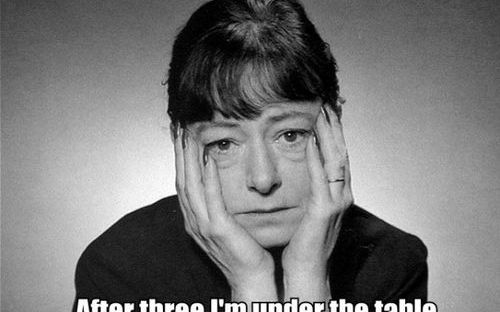
On women “mother-naked before long mirrors”: Dorothy Parker’s list of literary cliches to avoid
Recently I bought a copy of The Portable Dorothy Parker (Penguin Books, 1973) and am now reveling in her genius and wit. For those unfamiliar with Parker (1893-1967), she was a writer and columnist whose book reviews frequently appeared in The New Yorker (1927-1933) and Esquire (1957-1962). In the few reviews I've written, I often feel compelled to be … Continue reading On women “mother-naked before long mirrors”: Dorothy Parker’s list of literary cliches to avoid
Kerouac in Minnesota (January 1949)
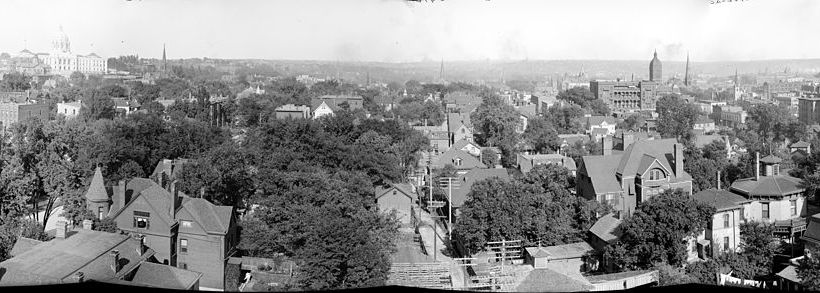
As part of my continuing research into the diary as a genre of literature, I came across the following from Windblown World: The Journals of Jack Kerouac, 1947-1954 (2006). ... "This famous river port still has the old 1870 brick along the waterfront ... now the scene of great fruit and wholesale markets, just as in Kansas City near the downhill Missouri shore. St. Paul is smaller and older and more rickety than Minneapolis, but there is a depressing Pittsburgh-like sootiness about it ... even in joyous snowy winter. Minneapolis is a sprawling dark city shooting off white communities across the montonous flats. The only soulful beauty here is rendered by the Mississippi and also by a hopeless hint of Mille Lacs and the Rainy River country to the North. The people are eastern (of course it's called 'middlewestern') city people; and their corresponding look, talk & absorptions. Blame it on me; I hate almost everything. I would have liked to see Duluth merely because of Sinclair Lewis and Lake Superior."
The Writers with a Foot in Two Centuries
For the last several months I’ve been writing a semi-autobiographical novel about growing up in rural Minnesota, running west to the Kerouac School, and back south to Houston. In particular, there’s a focus on the personalities who’ve crossed my path, but it’s also a meditation on the hometown. To quote the poet Bill Holm, it’s true that “We travel to get a better look at home,” but what I see from afar is the woman-witch illusion. The pictures flip back-and-forth, and though I’m grateful for much it’s hard going home – because what am I going back to?